

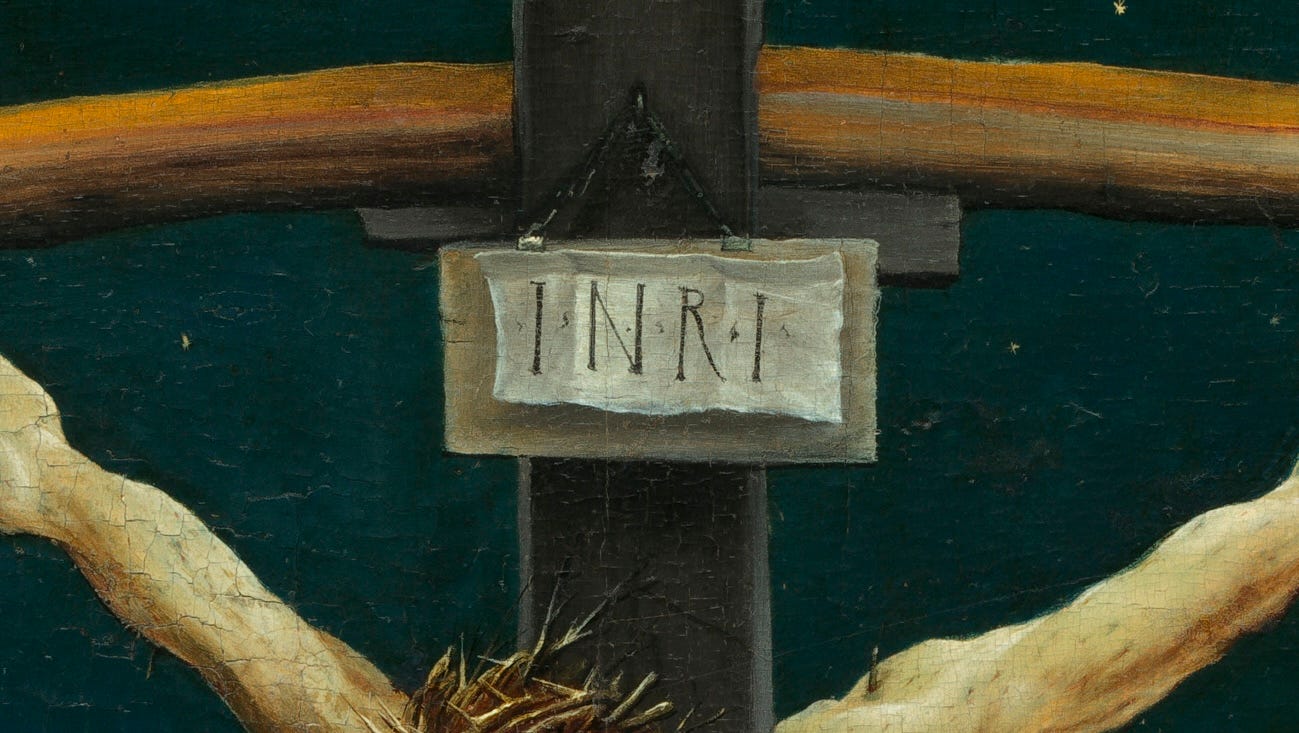
The Crucifixion begins with the humiliation of Christ’s enemies, and a civil declaration – even if intended as ironic – of his Kingship.
Editor’s Notes
Fr Coleridge’s account of the Cruxifixion covers two long chapters, and so it is necessary to start it before Good Friday, and to continue it after Easter Sunday.
There is no problem here, because there is no time in which it is unfitting to recall the Passion of Christ. Even in Eastertide, the Church traditionally commemorated the Cross in the Divine Office. The Cross is evergreen – and each season derives its meaning from the Cross, and sheds its own light upon it. In Eastertide, this commemoration reminds us that the Passion was not a defeat or something to be forgotten, but the glorious triumph of Christ.
In this first part, he considers the setting – and Pilate’s humiliation of the High Priest and authorities that sought Christ’s death.
For more on Maundy Thursday itself, see here:

As a further aid for meditation, The WM Review, Father Coleridge Reader and Catholic Hub last year produced a recording of Fr Coleridge’s harmonisation of the Passion narratives:
Calvary
The Passage of Our Lord to the Father
Chapter XII
St. Matt. xxvii. 35–44; St. Mark xv. 24–32; St. Luke xxiii. 34–43; St. John xix. 13–27; Story of the Gospels, § 170.
Burns and Oates, London, 1892
Pilgrims finding what they do not expect
We have already tried to trace the footsteps of our Lord from the Prætorium of Pilate, along the Sacred Way of the Cross, up to the summit of the hill of Calvary. He was already at no great distance from the remaining spots, rendered venerable to us by their connection with the last incidents of His Life and Death and Burial—the place, where for the last time He was stripped of His garments, where He was nailed to or raised on the Cross, where He breathed His last, where His Body was taken down from the Cross on which it had hung, and where finally it was placed in the new tomb, hewn for himself in the rock by St. Joseph of Arimathea.
A careful examination of the Sacred Texts will satisfy any one who makes it, that they prepare us to find all these spots very close one to another, and the surprise which we naturally feel at the fact is only a result of a want of such an examination. The modern pilgrim whose chief object is the feeding of his devotion, will do well to be prepared to find many things as he had not expected. Such is inevitably the case when we visit, for the first time, spots of which we have read and thought very much, and about which our imagination has often drawn pictures of its own. The greatest wonder of all would be if we found nothing to perplex us at first sight.
Another thing to be noted here, is the comparative fewness of the details, and indeed of the words themselves, in which the Evangelists have spoken of the incidents with which the present chapter has to deal. Brevity, indeed, is their characteristic all through their words; but we expect, when we approach the story of the last hours of our Saviour, that we shall find them less succinct and more inclined to expand their narratives. If it had been so, they would hardly be Evangelists at all, and to those who can read them most devoutly, they are in fact the most eloquent of historians, with a Divine eloquence which becomes those who have to speak of the greatest acts of God since the creation of the universe.
Arrival at Calvary
Our Blessed Lord arrived at Calvary, as far as we can speak with an approximation to accuracy, some time before noon. St. Mark tells us that it was the third hour, by which we understand him to mean, as has been said, that it was not yet the time when the space of three hours, beginning from nine in the morning, was entirely finished. The delivery of our Lord by the priests to Pilate had been about six o’clock, and three hours may very well have been occupied by the events of the interval since that time, which had involved, moreover, not a few passages from place to place, which could hardly have been very rapid, as well as the procession from the Prætorium to Calvary.
The little hill-top was not a frequented place, but if it was the common place for the execution of criminals, it would ordinarily be shunned and avoided. On this morning, however, it would naturally have become thronged by people, even before the little procession which escorted our Saviour to His Death had appeared outside the gate.
The crowd would naturally go on increasing, and by the time that the procession itself reached the spot, the throng would be immense. Our Lord was met on the place of execution by the two malefactors, who were to be crucified with Him. The fact can hardly have been accidental, especially as we find St. Mark, the reporter of St. Peter’s reminiscences, who but very seldom goes out of his way to bring in the fulfilment of prophecy, mentioning carefully that our Lord’s crucifixion between the thieves was such a fulfilment, Isaias having predicted of Him that ‘with the wicked He was reputed.’
The title on the Cross
We have also already mentioned the title of the Cross, written by Pilate in three languages, that all might be made aware that our Lord was officially declared the King of the Jews.
It may have been said to have been written before the procession to Calvary set forth. It is also possible that it was not put before the eyes of the public till the time for the Crucifixion came. Then it appears the priests made their objection to it, and may have thought that it was a ruse of Pilate, intended to humiliate them, and as a triumph of his own over their national pride, which certainly ought to have been affronted by the title he had written.
The right time for attaching the title may have been when it was to be fixed on the Cross after our Lord had been raised upon it, but it does not appear that Pilate himself was present at the Crucifixion. The title may have been written, as has been said, some time before it was thus publicly manifested, and the remonstrances of the Chief Priests made when they discovered the apparent trick which had been played upon them.
To the same preliminary stage of the actual execution would belong also the cup mixed of wine and gall or myrrh, which our Blessed Lord having tasted, would not drink. It is thought that this cup was ordinarily presented to persons who were to be executed, and that it might be expected to have a two-fold effect, first in strengthening them under the pain they were to suffer, and then in numbing the senses so as to make the feeling of pain less.
Our Lord may have been willing to help His natural forces somewhat by the strength supplied by the wine mingled with the bitter ingredients mentioned, but not to any great extent, that He might suffer as much as possible, but He would not wish for any deadening or drowning effect in Himself, as He would not care for any drugging, as it might seem.
All these little things were received by Him with gratitude, as far as they came from sympathy and compassion, but He can hardly be thought of as willing to have His sense of suffering clouded.
Calvary
Read Next:
Here’s why you should subscribe to The Father Coleridge Reader and share with others:
Fr Coleridge provides solid explanations of the entirety of the Gospel
His work is full of doctrine and piety, and is highly credible
He gives a clear trajectory of the life of Christ, its drama and all its stages—increasing our appreciation and admiration for the God-Man.
If more Catholics knew about works like Coleridge’s, then other works based on sentimentality and dubious private revelations would be much less attractive.
But sourcing and curating the texts, cleaning up scans, and editing them for online reading is a labour of love, and takes a lot of time.
Will you lend us a hand and hit subscribe?
Follow our projects on Twitter, YouTube and Telegram:
Twitter (The WM Review)