

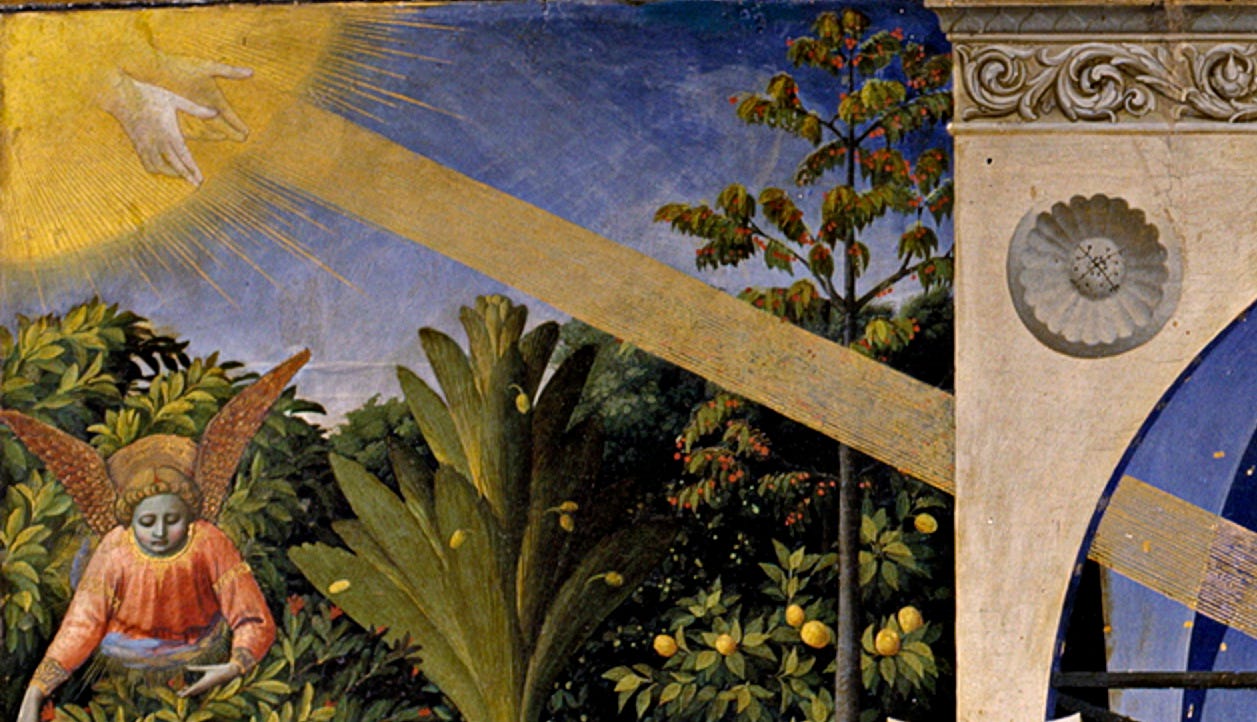
God prepared the world for his Son not only by words, but by people, events and institutions – and the promise was always meant for every nation.
Editor’s Notes
This Advent we are beginning a new series on prophecy, from Fr Henry James Coleridge SJ’s The Preparation of the Incarnation.
Advent is a time when the Church thinks about Christ’s coming in the flesh at the first Christmas, in each man’s soul, and at the end of the world. In many cases, the prophecies of the Old Testament pertain to all three of these “advents”.
In this chapter, Fr Coleridge stands back and looks at that long expectation as a whole. Prophecy, he shows, was not a scattering of remarkable predictions, but one connected work of God, running from the beginning of the world to Bethlehem, by which he prepared his people to recognise their Saviour when he came.
This work makes an ideal companion to the Advent liturgy, so full of the words of Isaias and the other prophets.
In this piece, Father Coleridge tells us:
How the Old Testament keeps all nations in view, even while its story centres on Israel
That Israel was set apart so that it could recognise the Redeemer when he came
Why prophecy comes in three forms: words, lives and events, and institutions like the sacrifices
He shows us that the whole Old Dispensation was one great preparation, and that its many lines of light all converge on Christ.
Prophecy in General
The Preparation of the Incarnation
Chapter II
Burns and Oates, London, 1894.
(Headings and some line breaks added.)
Universality of the scope of Sacred Scripture
The Sacred Scriptures of the Old Testament cover the whole space of time, from the creation of the world to the execution of the great counsel of the Incarnation, with the exception of a short period more immediately preceding that great act of the mercy of God. They begin with the whole race of man as the subject of the history, and it is not till after the Flood that the stream becomes, as it were, narrowed to the one chosen people of God, the nation which He made in a special sense His own, and to which He confided in a peculiar manner the promises which were nevertheless the common heritage of the race.
Soon after the narrative of the Flood, we have the famous chapter in which the various nationalities which sprung from the three sons of Noe are summarily enumerated and then, as it were, dismissed. When the promise is confined in a special manner to the issue of Abraham, it is confined in words which refer to the blessing of all nations of the world by means of the promised Seed.
That is the usual formula in which the peculiar privilege of the chosen race is conveyed. The universality of the scope of Sacred Scripture is never abandoned. The history centres in Israel, but Israel is itself the centre of the world and of the human race.
The Gentile nations never forgotten
The other nations around the chosen people are never forgotten. God speaks to and deals with them by His prophets, as well as with the kingdoms of Juda or Israel.
Some of the Hebrew prophets themselves are sent either exclusively to nations other than their own, or they include such nations in their prophetic office by the side of their own. Egypt, Assyria, Damascus, Niniveh, Persia, and Greece are spoken of, and dealt with, as well as the nearer nations more kindred to Israel, Edom, Moab, and the rest.
The last of the four greater prophets gives us a Divine sketch of the great Empires which had succeeded one another, or were to succeed one another, as the rulers of the whole world. Not only were these nations as present as Israel in the mind and heart of God, but they are addressed, reproved, rebuked, exhorted, warned, and threatened as well as the Jews.
The loftiest flights in the glowing poetry of the Evangelical Prophet are those in which the dominion and glories of the worldwide Church are foreshadowed. Even when Aggeus speaks of the coming of the Lord to His Temple, which was then being raised from its ruins by Zorobabel, he speaks of Him as ‘the Desired of all nations.’1 That Temple was to be ‘the house of prayer to all nations.’2
It was the privilege of the chosen race that it should be the instrument to the rest of the nations of the salvation which had been promised to all from the beginning. The word was to go forth from Jerusalem, but the redemption which it proclaimed was for the whole world.
Scripture the history of revelation
The history of the Old Testament is the history of revelation, and especially of the preservation and training of the chosen people with whom were deposited the promises of God. Israel was chosen as the nation from whom the promised Redeemer was to proceed. In order that it might be able to recognize Him and welcome Him when He came, it was separated from other races, made the object of a peculiar providence.
Its laws and polity, as well as its religion and creed, were cast in a peculiar mould. It was the recipient, from time to time, of a long series of prophecies in which the original promise was constantly repeated, made more definite and full, and gradually expanded into a large and glorious system. The Jews, especially after their deliverance from Egypt, lived under a special arrangement in all respects, which, as a whole and in its every part, prepared them for the Messias and the Kingdom which He was to found.
We are thus brought at once to the consideration of the ordinance of prophecy, and it will be a part of our present business to trace out the various methods and ways in which this great ordinance of God was, so to say, administered. The Jewish polity and institutions provided, as it were, a home and custodians for the treasure of prophecy. This great gift was the very chief of their privileges. It deserves to be examined, in the first instance, by itself.
Various kinds of prophecy
The ordinance of prophecy must not be limited to the direct and verbal predictions which are commonly understood by that name. Those form a long and most wonderful chain, of which we shall say a few words presently. But the whole of God’s providential dealings with the world, and especially with His chosen people, may be considered as a long and ever-growing prophecy. Even particular predictions, personal and historical, of the future Redeemer, were made, not only verbally, but by the characters and incidents which belong to the sacred history.
The palmary instance of this, though it is but one among many, is the story of the Prophet Jonas. Not a word is recorded of him which can be considered as direct prophecy of the future Messias, and yet he is appealed to by our Lord as having prophesied His own Death and Resurrection on the third day. He prophesied these things by the incidents of his life.
The true account of prophecy is that which considers the whole of the Old Dispensation, as prophetic of the New, as intended by God to prepare the hearts and minds of the people for that which was to come after it, both in the Person and work of our Lord.
We may divide this witness of prophecy into the three following chief lines.
There are direct verbal prophecies.
There are prophecies by characters and incidents, such as the lives of the great heroes of the holy people, or by their exploits, like those of Samson and David and others.
There are the prophecies which consist in things, and institutions, and ordinances, the sacrifices of the Temple, the slaying of the paschal lamb, and the like, of which St. Paul has so much to say in his Epistle to the Hebrews, and of which he speaks summarily to the Galatians when he says that the Law was the “pedagogue of the people to bring them to Christ.”
In this view of prophecy, it is easy to see that the fulness of time could not be, until the whole of this great preparation had been gone through, and until the time came for the fulfilment in our Lord of all these various classes of predictions. On the other hand, there could not be a stronger evidence to the Gospel Kingdom when it did come, than the fact that all these various lines of light, so to say, converged to point out the accomplishment of the great counsel of God.
It is also easy to see that a large and multifarious system, such as that of the Christian Church, would require an equally large and manifold system of prediction to prepare the minds of men for it, and to be its evidence to them when the time came for it to be introduced into the world. When all that rightly belongs to this consideration is taken into account, it will seem more wonderful that the preparation for the Gospel should have been so soon accomplished, than that it should have been spread over so long a space of time.
In the next part, Fr Coleridge explains how the prophecies form one continuous chain, and why they were meant to explain the Gospel as well as foretell it.
Prophecy in General
From: The Preparation of the Incarnation
Here’s why you should subscribe to The Father Coleridge Reader and share with others:
Fr Coleridge provides solid explanations of the entirety of the Gospel
His work is full of doctrine and piety, and is highly credible
He gives a clear trajectory of the life of Christ, its drama and all its stages—increasing our appreciation and admiration for the God-Man.
If more Catholics knew about works like Coleridge’s, then other works based on sentimentality and dubious private revelations would be much less attractive.
But sourcing and curating the texts, cleaning up scans, and editing them for online reading is a labour of love, and takes a lot of time.
Will you lend us a hand and hit subscribe?
Follow our projects on Twitter, YouTube and Telegram:
Twitter (The WM Review)
Aggeus ii. 8.
Isaias lvi. 7.