

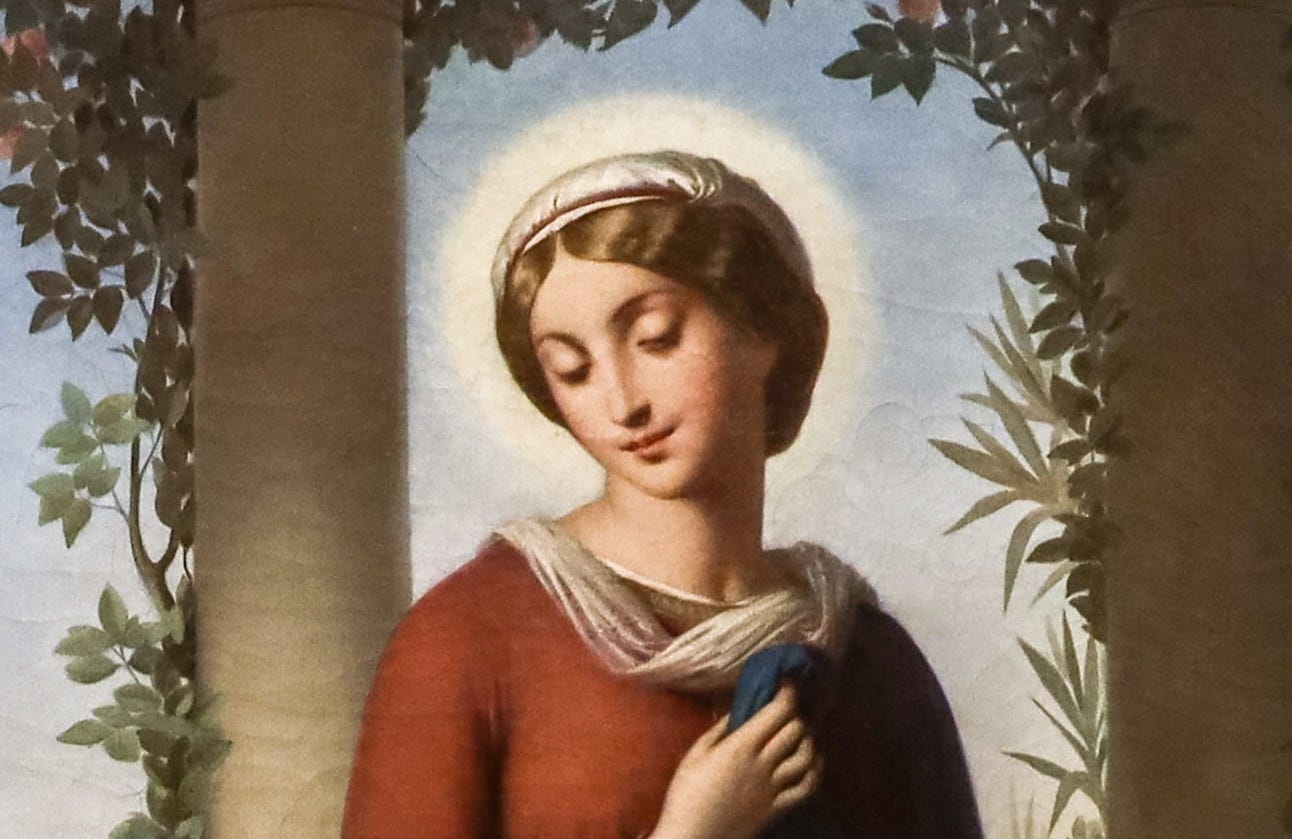
Even after it was known to a few chosen souls, the rest of the world carried on as if nothing had changed.
Editor’s Notes
To mark the Feast of the Annunciation, we are publishing the following text from Fr Coleridge’s The Nine Months, which focuses on the immediate aftermath of the world-changing event that had just taken place.
In former times, the Feast of the Annunciation was the start of the New Year. We see a relic of this in any jurisdictions beginning their tax year in April (the discrepancy being due to a change in the calendar) – and in The Lord of the Rings!
In this part, Fr Coleridge tells us…
How God made himself an infant, placing Mary in a wholly new relation to him
That his hidden presence among men calls for honour, though the world knows nothing of it
Why the burden of adoration and service first rested almost entirely on his Mother.
He shows us that, from the first moment of the Incarnation, God looked to Mary for the honour due to his presence.
The WM Review produced an audio meditation based on parts of this chapter as a part of the Preparing for Total Consecration series:

Our Lord’s Life in the Womb
The Nine Months
Chapter VII
Burns and Oates, London, 1885
Headings and some line breaks added.
God made an infant
One great Divine reason for the immense addition of graces and spiritual gifts which we believe to have been bestowed upon our Blessed Lady immediately after the Incarnation must be found in the new position in which she was placed to our Lord as His Mother.
This relation included a great variety of duties and opportunities, and on these we do not propose to linger in the present chapter. There is one most important element in this new position which should not be left unmentioned from the very first.
The change which had taken place in the world was infinite in its intrinsic wonderfulness and also in the duties which it imposed on the whole of Creation. God had become a creature. The material universe had now in its midst its Lord and Sovereign, not as He had always been in every part of the world which He had made, but in a new mode of existence, and that a human mode.
He had made Himself an Infant. He was still, and could never fail to be, the Lord and God of all, but He was now present among His creatures as one of them. He had thrown Himself upon them, leaving the throne and the glory and the majesty and the endless worship of Heaven behind Him, and He made Himself dependent on them for the homage and honour due to Him.
Analogy to the Blessed Sacrament
It sometimes happens in a land like our own, that a lonely priest begins a humble mission in some upper room, or in the kitchen of a cottage which he has hired.
He is sent in the hope that he may gather around him some few poor peasants, the workmen on a railway, or the toilers in a factory.
He has no home but that which he is obliged to use also for the time as his temporary chapel, and in the safest and loneliest spot in the little dwelling, he raises a poor altar. He does his best for its decoration.
Some poor servants help him with their savings, he is able to set apart altogether the small but decent room in which the altar is raised, and there, some morning, he has the happiness, not only of celebrating the Adorable Sacrifice but of consecrating a few hosts and enshrining the ciborium which contains them in a modest tabernacle.
There, for the first time since the change of religion, the Blessed Sacrament is reserved in that village or suburb. God has come to make His dwelling among men.
The secret worshipers
The world around knows nothing of its Neighbour.
No one suspects that in that little upstairs sanctuary is dwelling the God of gods, and Lord of lords. The house is the same as before, the village is the same as before, men come and go, and pass and chat, it may be offend the Divine Majesty within a few yards of His abode, it may be they lift up their hearts to Him, resist some temptation, or practise some simple charity, or refrain their tongue from evil words and their eyes from licentious looks, close by Him.
But all the time the good and the bad alike know nothing of His nearness; they think nothing of the choirs of Angels hovering around, giving to their King and Lord their homage all the more devotedly for the very reason that earth seems to know nothing of Him.
That priest and the few followers of the Faith who are in the secret feel in their hearts an immense light and happiness indeed, but also an immense weight of responsibility. They are in trust for the whole neighbourhood around, to show honour to the hidden King. If they fail Him, they do so advisedly and knowingly, and they feel that on their faithfulness may depend the issue, whether the boon of His presence is to be continued to their homes and their neighbours, or whether it is to be taken away again, never to return.
Mary’s office
Such in kind, though far greater in degree and intensity, must have been the feelings of the Blessed Mother of God at once, after the Incarnation.
Mary understood what had taken place as no one else could understand the condescension of God.
She knew His worth and rights, as no one among the highest seraphs knew them. She knew what was the blessing of His presence, and what the dues to His Majesty.
But He was her own. No ordinary presence, even as of the Blessed Sacrament in the tabernacle, was that in which He dwelt in her. He had taken His Flesh and His Blood from her substance. He lived by her life. He was sustained in His human existence by her.
She was nearer to Him than the priest who offers Him on the Altar, nearer to Him than the Angels who kneel in adoration wherever He is to be found; Flesh of her flesh, Bone of her bone.
And He was her own in the other sense, which involves so infinite a trust, so limitless a responsibility. She alone knew of Him. She alone was to discharge the duties of the whole visible creation in honour of Him, thanking Him, adoring Him, praising Him, loving Him for His condescension. If we can suppose Heaven emptied of its citizens, and one Angel alone left to adore the Divine Presence of the Ever-Blessed Trinity, we might compare that Angel’s thoughts with those of Mary.
It will certainly help us to understand the immense grace required for a position of this kind, to consider a little what that life was of our Lord which began at the moment of the Incarnation, and continued uninterruptedly for the nine months which had to pass before the first Christmas Day. It is a part of what we term in general the Holy Infancy, which has a kingdom of its own in Christian devotion, like the devotion to the Babe of Bethlehem, or to the many years of the Hidden Life at Nazareth. It contains both these, for it is the Babe of Bethlehem Who is dwelling in the womb of Mary. And never was He nearly so much hidden, even in the quietest years of His Life at Nazareth, as during these nine months.
It is clear that each part of this great devotion has its own features and characteristics. It is also clear that this phase of it can have been practised by no one from the beginning but our Blessed Lady herself, though at a point of time which is not directly discernible, it must have spread to St. Joseph, St. Elisabeth, St. John Baptist, St. Zachary. Moreover, it may have become known before the time came for the journey to Bethlehem to others of the immediate relatives of our Lady or her holy spouse.
We shall attempt in the few following paragraphs to give a short sketch of the considerations on which this great devotion has to feed itself.
Homage due to our Lord
God might have become Man without going through all the ordinary stages of human existence, including the first stage of all, the nine months in the womb of a Mother. But He did not choose to be different from us in this respect, and the consequence of His condescension is that we have to contemplate the theological truths which are involved therein.
We cannot imagine that this chain of wonderful and beautiful truths was unknown to our Blessed Lady and to St. Joseph, and to the other Saints mentioned above, in the order of time in which it pleased God that it should become known.
It is natural to think that the homage due to God Who had made Himself a creature was entrusted to them, and that it was not to be delayed until the humble birth at Bethlehem. We must suppose that God did not leave His own greatest work unrecognized and unhonoured, even though all the homage of angels and saints may be as nothing before Him.
A very short survey of this great field of contemplation, as we may suppose it to have been laid open to Mary and to others after her, must be enough for us here.
Our Lord’s Life in the Womb
Read Next:


Here’s why you should subscribe to The Father Coleridge Reader and share with others:
Fr Coleridge provides solid explanations of the entirety of the Gospel
His work is full of doctrine and piety, and is highly credible
He gives a clear trajectory of the life of Christ, its drama and all its stages—increasing our appreciation and admiration for the God-Man.
If more Catholics knew about works like Coleridge’s, then other works based on sentimentality and dubious private revelations would be much less attractive.
But sourcing and curating the texts, cleaning up scans, and editing them for online reading is a labour of love, and takes a lot of time.
Will you lend us a hand and hit subscribe?
Follow our projects on Twitter, YouTube and Telegram:
Twitter (The WM Review)
This seems like a fitting place and day to acknowledge the tremendous impact these writings of Father Coleridge have had on me this past year. Sometimes a writer comes into awareness whose thoughts and ways of expressing them play a new chord on the harp of the spiritual life--new to me, at least. I can completely see why you have devoted this substack (and very much time and effort!) to recovering his work. This article from The Nine Months, on Mary just after the Annunciation, is a perfect example. I have a new devotion to the Holy Infancy since reading Fr Coleridge (and Fr Abruzzi's Companion to the Spiritual Exercises) during last Advent and on into Lent. There is no discontinuity in turning to the Passion of Our Lord but rather a better appreciation of the whole arc of the great, incomprehensible gift and mercy of the life of our Incarnate Lord.
Thank you for all you do to share and introduce these writings!