

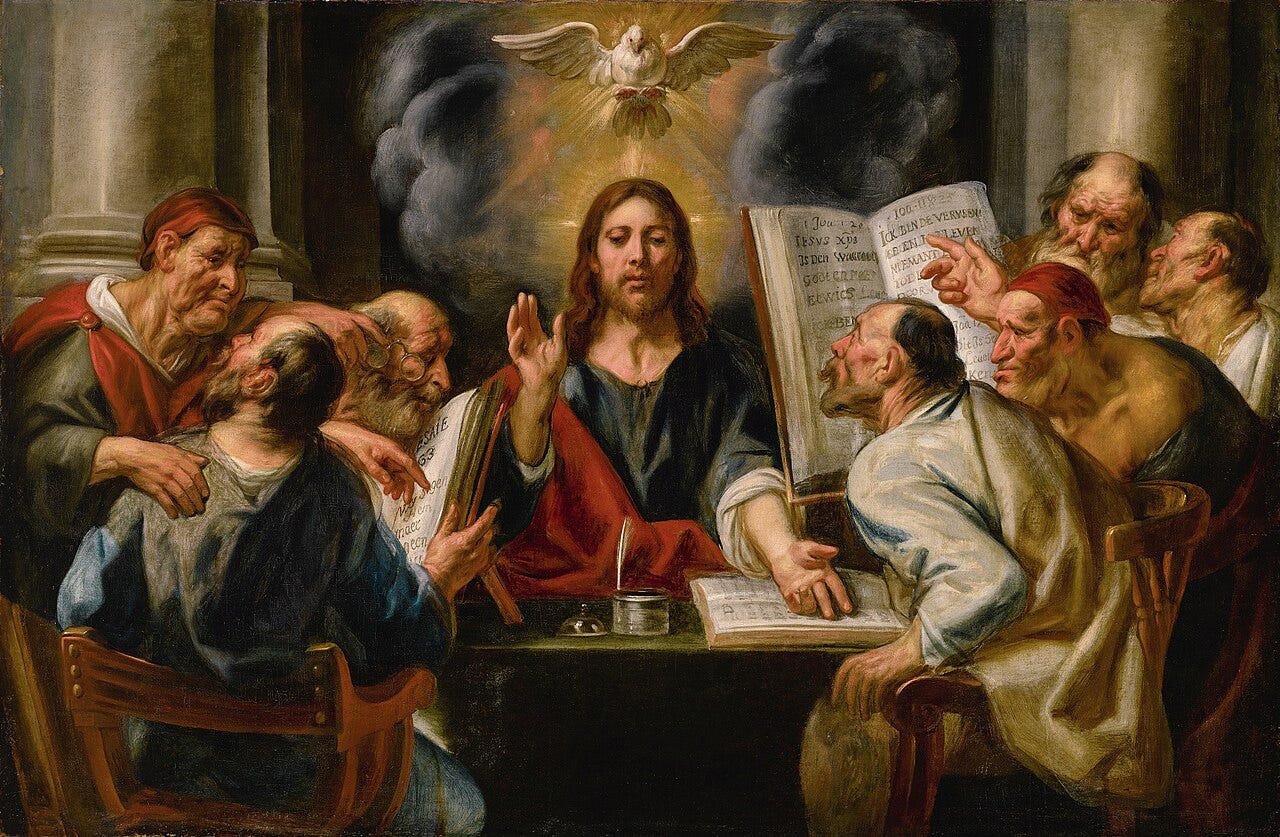
Their malice itself, from which they still could have converted, served to fulfil Our Lord’s divine plan.
Editor’s Notes
As we enter into Holy Week, and approach the Sacred Triduum, Fr Coleridge considers Our Lord’s entrance into his Passion.
How Christ reveals his majesty even amid his meekness and approaching Passion
That divine providence governs evil men’s actions without destroying their freedom
Why even Christ’s enemies become instruments in the work of redemption
He shows us that nothing – neither malice, confusion, nor betrayal – escapes his sovereign rule, but is ordered to the triumph of his sacrifice.
As a further aid for meditation, The WM Review, Father Coleridge Reader and Catholic Hub last year produced a recording of Fr Coleridge’s harmonisation of the Passion narratives:
Our Lord Entering on the Passion
Passiontide, Part I, Chapter II
Burns and Oates, London, 1889
Headings and some line breaks added.
Our Lord’s own demeanor
Our Lord, with all His ineffable meekness, seems Himself to have taught the Church, by His own demeanour and conduct during this time, the true aspect of the events which she then commemorates. For His words and actions are clothed with an air of unusual majesty and of peremptoriness in the face of His enemies, of which we shall have to trace the manifestations more than once.
These are terrible days of confusion, as they appear to us. Hell seems to be let loose in all the madness of its fury, and the miserable instruments of Hell are led on and on from one wickedness to another, which they had intended to perpetrate in a different manner and at another time. They contradict themselves and bear witness to our Lord against their will, at the very time that they are so full of malice against Him.
All this was arranged according to the eternal plans of God and the designs of His mercy for mankind. On each occasion during the ensuing days on which they had to use the free will with which God had endowed them, and the great power for good or for evil which belonged to their position and office, our Lord dealt with them calmly, even tenderly, and at the same time, severely. They were treated by Providence with strict solemn justice. The grace was offered them, by means of which they might, even then, have been converted.
But they were not hindered from rejecting it, and thus their actions became so many steps onward in the accomplishment of the great designs of God for the salvation of the world through their wickedness.
Use made of his enemies
It is well to observe how, at each step, in the work they had in hand, they were allowed to go just as far, and no farther, than it suited the plan of Redemption at that stage. Magdalene’s act of devotion was not hindered in order that Judas might be preserved from the danger of yielding to the final temptation which carried him away.
The Procession of Palms was not omitted, although it might provoke the Chief Priests to madness. Our Lord taught in the Temple with authority, having driven out from it the buyers and sellers, and He refused to give the explanations which the priests demanded of Him, although both His teaching and His refusal added fuel to the flame of enmity in their hearts. He denounced the Scribes and Pharisees to the people, at the very time that He taught that they were to be obeyed as sitting in the seat of Moses.
It was the same all through. If Judas had known the place where the Paschal Supper was to be eaten by our Lord, he might have secured His arrest without tumult, as the Chief Priests wished. But this was not allowed him. Yet our Lord, for a purpose dear to His own Sacred Heart, arranged that Judas should leave the Cenacle before the others, and unsuspected by them.
It was the plan of Providence that the arrest should take place at Gethsemani. When the armed band fell to the ground before Him, on His announcing ‘I am He,’ the same power which laid them prostrate could have blinded their eyes at once, or made them turn their weapons against themselves. But that ‘was their hour and the power of darkness.’
Everything was to proceed according to the order predetermined in the Divine Counsels, as Daniel said so many years before, speaking of the fixed time in the course of ages ‘that transgression may be finished, and sin may have an end, and iniquity may be abolished, and everlasting justice may be brought, and vision and prophecy may be fulfilled, and the Saint of saints may be anointed.’1
In this solemn act His enemies are all the servants of our Lord in bringing about His Sacrifice. And yet they are all free agents, who have opportunity after opportunity given them of drawing back from their sin. They all fall into their place in the great sacrificial procession. Most truly, in that sense, they did not know what they did.
All the types of the Law, all the rites of sacrifice, all the prophecies were fulfilled. The Eternal Son of God in His Human Nature was to offer Himself on the altar for the redemption of the world, and all things served and obeyed Him as ministers in their measure in the sacred rite.
The priests and the people—though the latter, at least, were His friends; and the representative of the empire of the world—though he wished to hinder the crime, and wrote up officially over His head that He was the King of the Jews; the apostate Apostle—though our Lord knelt at his feet to win his repentance; the very devils themselves—although, as is thought by some, they endeavoured at the last to prevent the consummation of their own triumph, lest it should lead to their destruction—all and each bore his or their part in this the most solemn act of worship and expiation that the universe ever saw. It was an occasion immeasurably greater than the creation of angels and men, and the whole physical world, out of nothing.
All serve him
It is impossible to suppose that the infinite greatness of the act which He was performing, or any of the great results which were to follow in Heaven and on earth from the Passion of our Lord were hidden from His own mind, and were not lovingly counted up in His Sacred Heart.
On the contrary, if it were possible to suppose Him to have been ignorant of what He was doing, we should know from His own language that He was dwelling upon all these things with an intensity of desire of which no heart but His own was capable.
The measure of His desire, and of the love with which He contemplated them, was the measure of His love for God and for man, of His intelligence concerning the greatness of the fruits of which the Passion was to be the cause.
He alone knew what it was to be a Redeemer.
Our Lord Entering on the Passion
Read Next:
Here’s why you should subscribe to The Father Coleridge Reader and share with others:
Fr Coleridge provides solid explanations of the entirety of the Gospel
His work is full of doctrine and piety, and is highly credible
He gives a clear trajectory of the life of Christ, its drama and all its stages—increasing our appreciation and admiration for the God-Man.
If more Catholics knew about works like Coleridge’s, then other works based on sentimentality and dubious private revelations would be much less attractive.
But sourcing and curating the texts, cleaning up scans, and editing them for online reading is a labour of love, and takes a lot of time.
Will you lend us a hand and hit subscribe?
Follow our projects on Twitter, YouTube and Telegram:
Twitter (The WM Review)
Daniel ix. 24.