

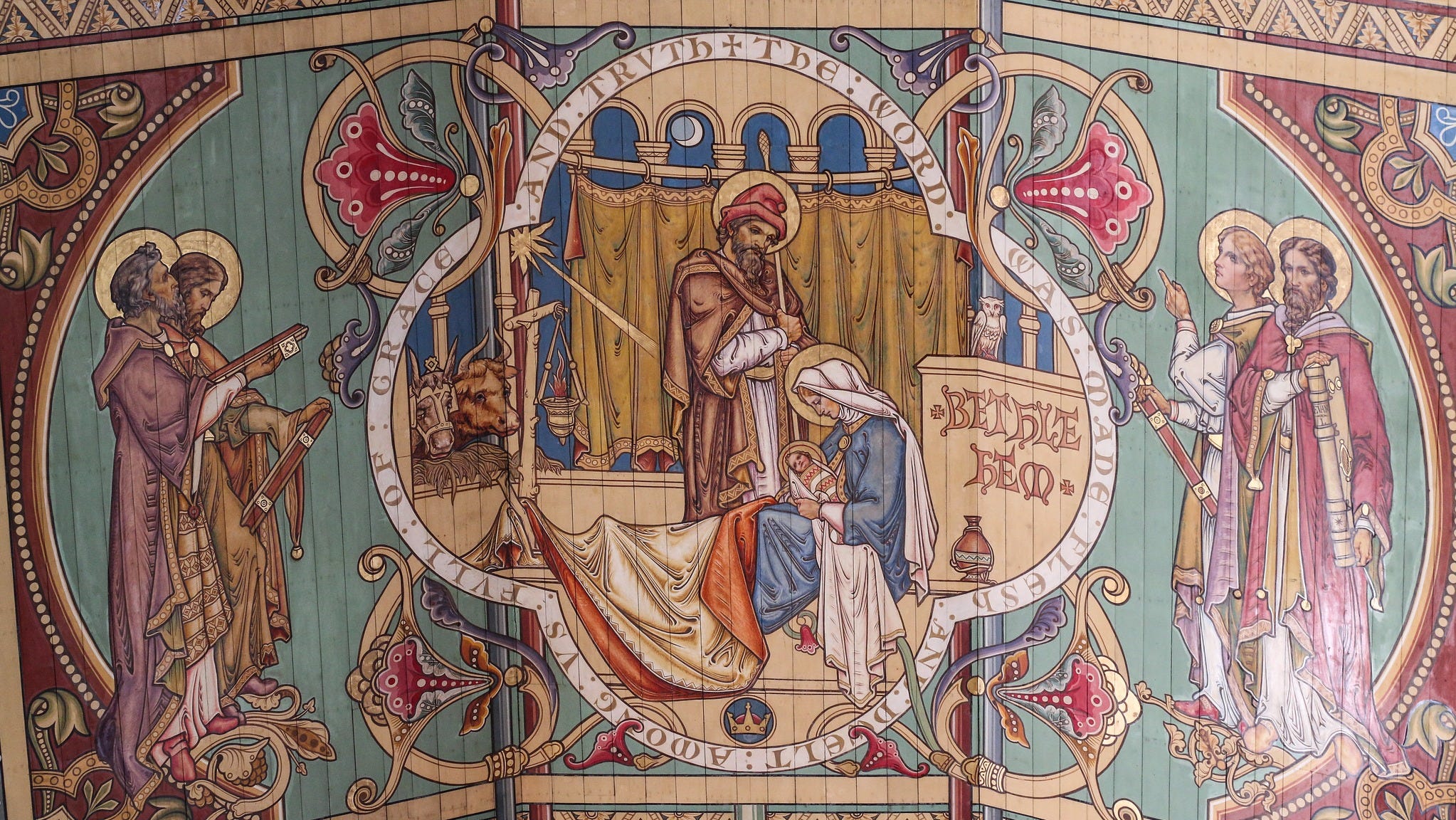
She was a virgin before, during and after the birth of her Divine Son.
Editor’s Notes
Merry Christmas from Father Coleridge Reader and The WM Review!
You can hear an abridged and adapted version of parts of this chapter here, which featured as part of The WM Review’s series Preparing for Total Consecration to the Blessed Virgin According to the Method of St Louis de Montfort:
In this part, Fr Coleridge tells us…
How Luke’s sparse narrative through traditional details of Bethlehem’s circumstances
That Mary’s virginal childbirth occurred without pain, preserving perfect integrity through divine power
Why The Nativity reveals God’s condescension meeting human indifference with miraculous maternal joy
He shows us that the poverty of Christ’s birthplace paradoxically highlights the glory of a Virgin Mother bringing forth God Himself with ineffable delight rather than suffering.
The Nativity of Our Lord
The Thirty Years
Chapter I
St. Luke i. 6, 7; Vita Vitæ Nostræ, § 8.
Burns and Oates, 1915
(For Christmas)
What happened at the first Christmas? Did Our Lady suffer the pangs of childbirth?
Here’s why Our Lady’s perpetual virginity is a necessary Christmas truth
Mary’s perpetual virginity
The privilege of the Virginal Childbearing has always been considered in the Church as the foundation of the perpetual Virginity which is ascribed to Mary during the whole of her life. This again appears to rest on a universal tradition. The reasons for this belief are so plain, the truth approves itself so clearly to the simple Christian instinct of reverence to our Lord, that it is not easy to imagine that those who deny or question it can really believe that He is the Son of God.
The truth is thought by many of the Christian writers to be set forth in the passage in the Prophet Ezechiel, where it is said of the gate of the Temple:
“This gate shall be shut and no man shall pass through it, because the Lord the God of Israel hath passed thereby.”1
The language is metaphorical, but it seems to belong to no one so naturally as to our Blessed Lady. A further argument from Scripture is found in the history of the Annunciation, that is, in our Lady’s own words to the Angel:
“How shall this be done, seeing that I know not man?”
If these words convey a peremptory reason why our Blessed Lady, before she was the Mother of God, should not be able to conceive a child in the ordinary way, it must be certain, with a still higher degree of certainty, that there was in her condition, with reference to this matter, a still more peremptory reason against the possibility of any conception on her part at a later period.
If our Lady was bound by a solemn obligation to God to remain a Virgin at the time of the Annunciation, it is certainly incredible to suppose that such an obligation did not exist afterwards. It might indeed have occurred to a devout mind, that, if it could have been possible in the counsels of God that our Lord might have been born of one who was not the purest of Virgins, at least after that Divine Birth His Mother must have remained intact.
But to imagine that His Mother had been at the time of the Annunciation consecrated to God by a vow of perpetual virginity, and that this vow was to be violated after the Birth of the Incarnate Son of God, is to imagine something altogether inconsistent alike with reverence to Him and a due estimate of her transcendent virtues.
Fruitfulness of the doctrine
This doctrine of the perpetual Virginity of the Blessed Mother of God has been so fruitful of good in the Church and in the world, that it may be worth our while to dwell a little on the theological reasons which are assigned to it by the great Christian writers.
It is not that there can be any doubt of the truth in any mind that has learnt to think rightly concerning our Lord and His Blessed Mother. All that has hitherto been said concerning her wonderful elevation in the order of grace must be forgotten, before any idea of this kind can enter the mind except to be rejected with indignation and disgust, except in so far as it may be the fruit of an ignorant opinion, founded on a mistaken interpretation of the Scriptures, of which we shall speak separately.2
The reasons to which we refer are to be found in the Summa of St. Thomas, set forth in his wonderfully concise and pregnant manner, and the devout commentator Suarez has added one more of his own.3 St. Thomas simply takes the persons concerned in the execution of the mystery of the Incarnation, and shows in a few words how indecent and incongruous it would have been for them if the Helvidian slander had been true.
Our Lord Himself is the only-begotten of His Father, Who pours out in His Eternal Generation the whole, so to say, of His Paternity. He communicates to His Son His whole substance, and makes Him the complete and perfect expression of His own Infinite Being. It would have been indecent and unfitting if He had been but one of many children of any earthly mother, sharing with them her maternal fertility, her care and love, which could belong after Him to no other.
On the part of the Holy Ghost, by Whose operation our Blessed Lady had become the Mother of her Divine Child, it would have been unbecoming in the highest degree if she whom He had made His own sanctuary for the production and nurture of the Sacred Humanity, had afterwards been touched by any other. No profanation of a material temple, or of any sacred vessel which had been consecrated to the holiest purposes, could be equal in indecency to this.
Theological reasons
Moreover the Blessed Mother herself, even putting aside her Virgin consecration of herself, would have shown both incontinence and ingratitude for the highest favours ever bestowed on a created being, if she had sacrificed that Virginity which had been preserved by a special miracle, and allowed the chamber in which Christ had been conceived and fostered to suffer pollution.
There is the same indecency to be supposed under this hypothesis in the blessed Joseph. We have seen that he is spoken of in the Gospels as one of singular justice, purity, and reverence. We have seen how the knowledge of the Divine Conception, which had taken place in the womb of his most beloved bride, filled him with so much of holy awe, that he was thinking of leaving her side, rather than intrude himself as her husband into the following out of the great mystery of the Incarnation.
It is certainly most fitting and most reasonable to think that, after the marvellous birth had taken place he would have been at least as full of reverence for Mary as before. And besides, we have seen that he shared, from the very time of their marriage, if not before, the holy purpose of continence in the married state which she had been the first to conceive.
You can find an abridged and adapted recording of this chapter here, which featured as part of The WM Review’s series Preparing for Total Consecration to the Blessed Virgin According to the Method of St Louis de Montfort:
The Nativity of Our Lord
What happened at the first Christmas? Did Our Lady suffer the pangs of childbirth?
Here’s why Our Lady’s perpetual virginity is a necessary Christmas truth
Here’s why you should subscribe to The Father Coleridge Reader and share with others:
Fr Coleridge provides solid explanations of the entirety of the Gospel
His work is full of doctrine and piety, and is highly credible
He gives a clear trajectory of the life of Christ, its drama and all its stages—increasing our appreciation and admiration for the God-Man.
If more Catholics knew about works like Coleridge’s, then other works based on sentimentality and dubious private revelations would be much less attractive.
But sourcing and curating the texts, cleaning up scans, and editing them for online reading is a labour of love, and takes a lot of time.
Will you lend us a hand and hit subscribe?
Follow our projects on Twitter, YouTube and Telegram:
Twitter (The WM Review)
Ezech. xliv. 2.
See Note A at the end of this volume.
St. Thomas, part iii. q. 28, art. 5; Suarez, De Mysteriis Vitæ Christi, disp. v. § 4.
This reflection sheds light on priestly celibacy. It would be indecent for any man to give himself to another, once he has pledged his life to God, and through Holy Orders been given the power to consecrate the bread and wine, and minister other sacraments, but especially the Holy Eucharist.