

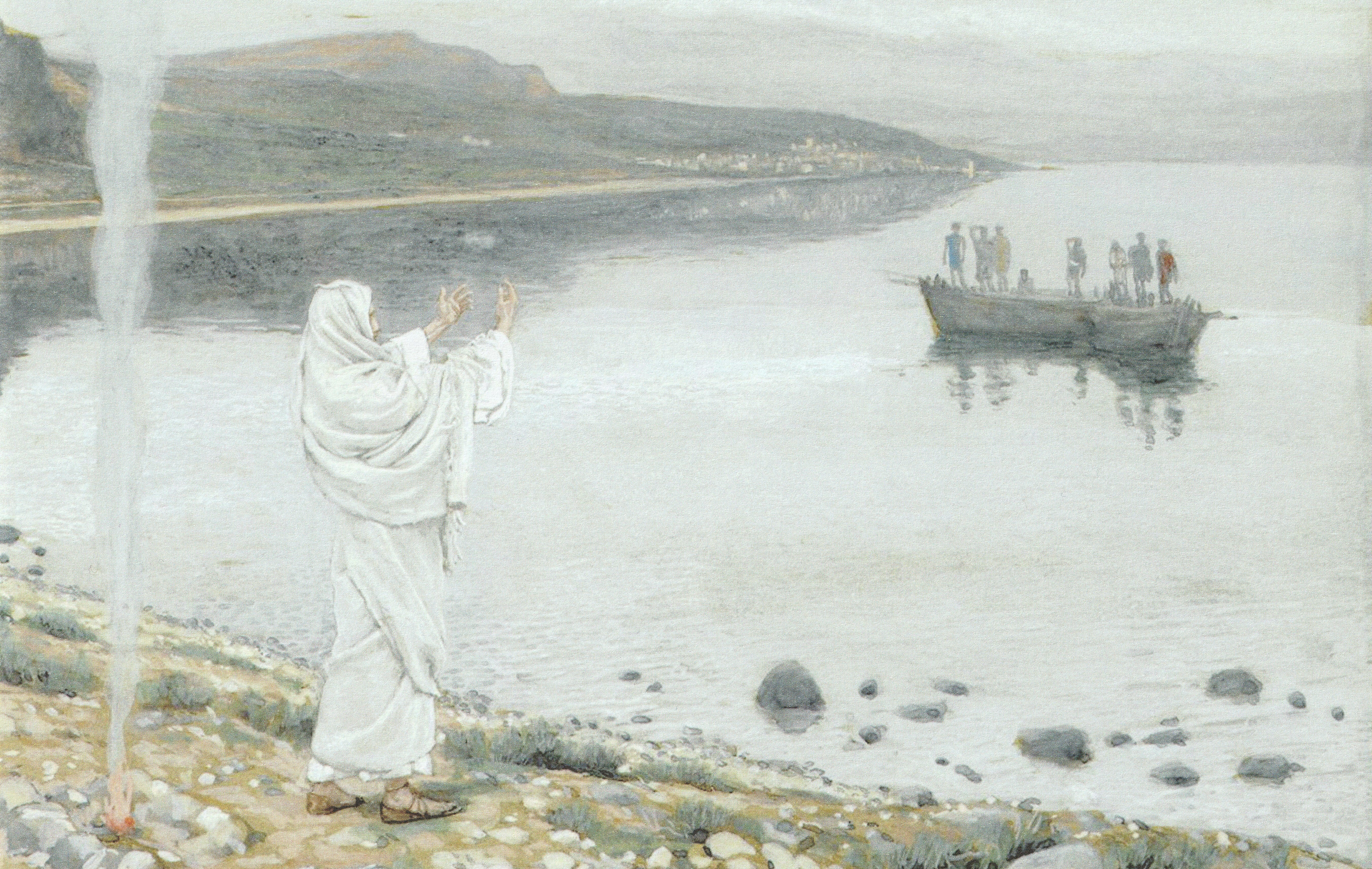
In a quiet moment by the Sea of Tiberias, Christ revealed Himself again to His Apostles. These encounters were few, but they were formative, shaping the foundation of the Church.
Editor’s Notes
Many believe that Christ made St Peter the Pope when he changed his name and talked about “the keys of the kingdom of Heaven.” In fact, the Church teaches that St Peter’s profession of faith gave rise to a promise of the primacy, which was ultimately bestowed following his threefold profession of charity:
We teach and declare that, according to the gospel evidence, a primacy of jurisdiction over the whole church of God was immediately and directly promised to the blessed apostle Peter and conferred on him by Christ the lord.
It was to Simon alone, to whom he had already said:
You shall be called Cephas, that the Lord, after his confession, You are the Christ, the son of the living God, spoke these words: Blessed are you, Simon Bar-Jona. For flesh and blood has not revealed this to you, but my Father who is in heaven. And I tell you, you are Peter, and on this rock I will build my church, and the gates of the underworld shall not prevail against it. I will give you the keys of the kingdom of heaven, and whatever you bind on earth shall be bound in heaven, and whatever you loose on earth shall be loosed in heaven.
And it was to Peter alone that Jesus, after his resurrection, confided the jurisdiction of supreme pastor and ruler of his whole fold, saying:
Feed my lambs, feed my sheep.
You can read more about this here:

In this part, Fr Coleridge tells us…
How Christ’s appearance by the lake renewed the Apostles’ faith and revealed their mission.
That this manifestation gave hidden signs of the Church’s future and Christ’s care.
Why the quiet joy of the forty days shows how deeply Christ transformed His disciples.
He shows us that the risen Lord came not only to console, but to prepare His Apostles to feed His flock.
Last Words by the Lake
The Passage of Our Lord to the Father
Chapter XV
St. Matt. xxvii. 45-61; St. Mark xv. 33-47; St. Luke xxiii. 44-56; St. John xix. 28-42; Story of the Gospels, § 170, 171
Burns and Oates, London, 1892
How did Christ feed and teach the Apostles after his Resurrection?
How did the risen Christ reveal the Church’s divine constitution?
What does 'Feed My sheep' really mean for Peter’s role in the Church?
Night fishing in the Lake
After relating to us the events of the first Easter Day at Jerusalem, the blessed Evangelist St. John proceeds to give us an account of a manifestation of Himself to His Apostles by our Blessed Lord, which, as we understand the words, was the third time on which after the Resurrection He allowed the whole body to see Him at once, or at least a considerable part of their number. St. John enumerates them carefully.
‘He showed Himself after this manner. There were together Simon Peter, and Thomas, who is called Didymus, and Nathanael [that is, Bartholomew], who was of Cana of Galilee, and the sons of Zebedee, and two others of His disciples.’
If we except St. Matthew, and the Apostles who belong to our Lord’s own kindred, St. Simon and St. Jude and St. James the Less, we have thus the whole company included. It is easy to suppose that some of them were not fishermen, or had some reason for absence elsewhere. And although there could have been no difficulty about their finding place for so large a body as the whole Apostolate, it is not said that on this occasion they were in the immediate neighbourhood of any of the numerous towns or villages by the Lake itself.
This manifestation is said by St. John to have been made by the Sea of Tiberias. There is therefore a complete change of place. It must have been after the end of the second week of the forty days which were to elapse after the Resurrection, that is, in the week which begins with what we call Dominica in Albis, up to which time the so-called incredulity of St. Thomas was allowed to last, our Lord then showing Himself to him.
We fix the time in this way, and perhaps it is natural to think that about a week may have been consumed in the journey of the small band of disciples from Jerusalem to Galilee, and their partial dispersion.
The miraculous draught
This time there was no fear of the Jews, and they were free to assemble as they liked, but the incidents of this period are not many.
‘Simon Peter saith to them, I go a fishing. They say to him, We also come with thee. And they went forth and entered into the ship, and that night they caught nothing. But when morning was come Jesus stood on the shore, yet the disciples knew not that it was Jesus.’
Their labour had lasted the whole night, and it must have reminded them of former unsuccessful fishings in the same waters, and probably the hearts of many there present were full of the blessing with which our Lord had formerly rewarded them.
‘Jesus therefore said to them, Children, have you any meat? They answered Him, No. He saith to them, Cast the net on the right side of the ship, and you shall find. They cast therefore, and now they were not able to draw it, for the multitude of fishes. The disciple therefore whom Jesus loved said to Simon Peter, It is the Lord.’
He was ready to recognize any hint of a miraculous intervention from our Lord, Whom they may all have been disposed to expect suddenly. The fact of the multitude of fishes seemed to them something of itself miraculous.
Intelligence of the Apostles
Neither St. John nor St. Peter had any doubt as to the interpretation to be assigned to what had happened. Simon Peter, indeed, acted in a manner quite in keeping with his character.
‘Simon Peter, when he heard that it was the Lord, girt his coat about him (for he was naked), and cast himself into the sea. But the other disciples came in the ship (for they were not far from the land, but as it were two hundred cubits), dragging the net with fishes.
‘As soon then as they came to land they saw hot coals lying, and a fish laid thereon, and bread. Jesus saith to them, Bring hither of the fishes which you have now caught. Simon Peter went up and drew the net to land, full of great fishes, one hundred and fifty-three. And although there were so many the net was not broken.
‘Jesus saith to them, Come and dine. And none of them that were at meat durst ask Him, Who art Thou? knowing that it was the Lord. And Jesus cometh and taketh bread, and giveth them, and fish in like manner. This is now the third time that Jesus was manifested to His disciples, after He was risen from the dead.’
We are right in taking the words quite literally, and as implying that, whatever may have been the private manifestations made to this or that disciple or saint during this period, this was in truth the third, and the third time only, in which the whole body of the Apostles, or at least the greater part of them, had a share.
We need not understand this as contradicting the other Scriptural statement, that our Lord was for forty days manifesting Himself to them and showing Himself by many proofs, and speaking of the Kingdom of God. There seems to have been some difficulty, as may naturally be supposed, about their feeling perfectly at their ease with Him in the public manifestations which are recorded, but it may have been very different when they were able one by one to speak with Him alone, to lay open to Him all the secrets of their hearts, and to receive from Him the private personal instruction and exhortation which they so much needed, and the remembrance of which in after years must have been the chiefest treasure of each individual soul among them.
Their joy at this time
If we are to judge of the kind of intercourse which existed between them and our Lord only from the accounts of which we possess the records, such as that of which we have just heard the outline, we might be inclined to think that there would have been some disappointment left in their hearts when the precious interval of the forty days came to an end.
Whereas, on the contrary, we find them distinctly described as full of joy, and able to meet the time of separation which followed on the Ascension with perfect happiness and immense peace, without a trace of sorrow or regret for the visible absence of our Lord. They were able to set themselves without fear or repining to the great work which fell to their lot. That it was so, proves to us among other things that the period of the forty days was in a most wonderful way the foundation of a new life to them, little as we are told of the particulars and details.
It is well to keep in mind that the work which our Lord had to accomplish in the souls of the Apostles during this short time was marked by immense swiftness, and they must have a wonderful gift in cooperating with the illumination and the elevation of heart and mind which were now vouchsafed to them so largely.
It must be remembered always that there is one great subject that we know to have been ever present to our Lord (not to speak of His disciples), on which we know it to have been His object to dwell frequently in these conversations, but on which we find a remarkable silence in these records, namely, the constitution of the Church, for that seems to be the subject spoken of as the Kingdom of God.
Subscribe now to never miss an article:
Last Words by the Lake
How did Christ feed and teach the Apostles after his Resurrection?
How did the risen Christ reveal the Church’s divine constitution?
What does 'Feed My sheep' really mean for Peter’s role in the Church?
Here’s why you should subscribe to The Father Coleridge Reader and share with others:
Fr Coleridge provides solid explanations of the entirety of the Gospel
His work is full of doctrine and piety, and is highly credible
He gives a clear trajectory of the life of Christ, its drama and all its stages—increasing our appreciation and admiration for the God-Man.
If more Catholics knew about works like Coleridge’s, then other works based on sentimentality and dubious private revelations would be much less attractive.
But sourcing and curating the texts, cleaning up scans, and editing them for online reading is a labour of love, and takes a lot of time.
Will you lend us a hand and hit subscribe?
Follow our projects on Twitter, YouTube and Telegram: