

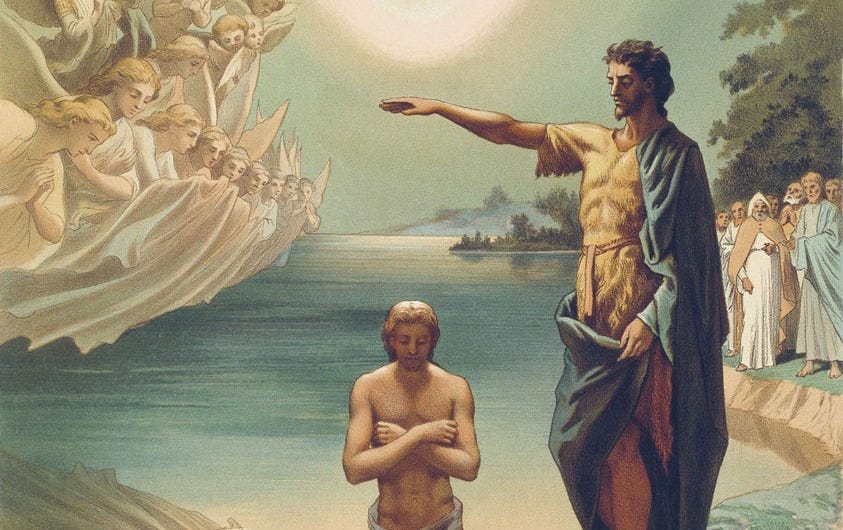
By receiving St John’s baptism, Christ obeyed the Father, sanctified the rite, and laid the foundation for sacramental baptism.
Editor’s notes
Before we proceed to the text: The WM Review’s Preparing for Total Consecration to the Blessed Virgin Mary series included Fr Aloysius Ambruzzi SJ’s meditation on the Baptism of Our Lord in podcast form. You can find that here:
For more context on this episode, see Part I.
In this part, Father Coleridge tells us…
How Christ honoured John’s baptism as a divine institution
That by receiving it, he imparted grace and prepared for the transformation of baptism into a sacrament.
Why this public act of humiliation marked the true beginning of his teaching mission.
He shows us that obedience and self-abasement are the necessary foundations of his authority.
Baptism of Our Lord
From
The Ministry of St. John the Baptist
Fr Henry James Coleridge, 1886, Ch. III
St. Matt. iii. 13–17; St. Mark i. 9–11; St. Luke iii. 21–23;
Story of the Gospels, § 17
Our Lord respecting St. John’s baptism as an ordinance of His Father
The baptism of St. John was, as we have seen, an ordinance of God, an arrangement of His providence with special reference to the dispensation of the Incarnation and of the redemption of the world thereby.
It was right, therefore, that all reverence should be shown to it, and that as our Lord had humbled Himself to undergo the rite of circumcision, to be presented in the Temple, and there redeemed by an offering, so He should also honour the appointment of the Father by the devout reception of the baptism of St. John. If it had led to nothing and implied nothing but itself, still, as the ordinance of God, it deserved reverence, and it became all to receive it.
When anything of the kind springs up in the Church or in the order of Providence, we are not to inquire whether we ourselves have special need of it, or whether it is a matter of obligation, but only whether the simple truth, that it comes, even indirectly, from God, and has become for the time a part of the system, or at least a thing in accordance with the spirit, of the Church, which is His Spouse, does not make it unfitting for us to hold ourselves aloof from it.
He gave it power by receiving it
In the second place, our Lord, by receiving circumcision, and by the other legal observances and ceremonies which He allowed to be performed in His regard, sanctioned and blessed them, and imparted to them, as it were by His own touch—the touch of the Incarnate Godhead—whatever power of sanctification, of conjunction with God, of remission of sins, and the like, which they possessed.
So also by receiving in His own Person the baptism of St. John, He gave to it from Himself the power, not indeed to act as a Christian sacrament, but to be the occasion of grace, reconciliation, and sanctification to those who had received it, or might receive it, in the dispositions which are the conditions of such spiritual benefits.
In this sense, again, it was a part of the fulfilment of perfect justice that He should receive that baptism, for it was His mission and work to be the source and fountain of all means and occasions of grace to the children of Adam from the beginning to the end of time.
Example of humiliation at the beginning of His course of teaching
In the third place, our Lord was about to begin the work of teaching, and take upon Himself the Evangelical and Apostolical functions of His ministry as the Master as well as the Redeemer of mankind. And it was and is the will and the rule of God that all teaching must be begun and founded in humiliation, as the means and safeguard of that humility, without which no one can be trusted by God with any commission to work for His glory.
But the receiving of the baptism of His Forerunner was a great and further act of humiliation on the part of our Blessed Lord. In His Circumcision and in His Presentation in the Temple He had gone through certain rites and observances, the significance of which was that He was to pay the penalty of original sin, although no such stain could possibly fall upon Him.
But by receiving the baptism of St. John He went still further, because that baptism was a public profession and confession that His state was that of an actual sinner. It implied that He had sins to confess and penance to do, whereas He had indeed penance to do and sins to confess, but they were the sins of the whole world, not His own, and their chastisement and penance were to be upon Him.
And as there is always to be the closest union between our Lord Himself and all those who in any way or measure have to carry on in the Church and to share His holy work of teaching mankind, He was, in this mystery, both setting them the example of the constant uniform practice of self-humiliation as the fit and appointed preparation for the exercise of such functions, and also blessing their humiliations in His own, strengthening them and giving them virtue thereby, making them the occasions and conditions of success and of exaltation to be granted them on the part of His Father, and warning all that they must never shrink from such, as if the authority of a teacher and his fruitfulness in teaching could ever suffer thereby.
These are some of the reasons for this action of our Lord, considered in itself as an act of simple humiliation, in obedience to what at that time was the arrangement of His Father’s Providence.
He was to make Baptism a sacrament
But the Baptism of our Lord had also another aspect. It was not merely that He received the baptism of St. John as He received the rite of circumcision, which was to be entirely done away with under the New Law.
He was to take up the rite which St. John had adopted as the symbol of his mission and as a profession of penitence and faith, and make it into a Christian sacrament, and that sacrament the most fundamental and essential of all. And this was to be done at the moment when He Himself was to be solemnly and manifestly anointed for His own office as Redeemer and Prophet.
Thus, in the Christian scheme, our Lord’s Baptism has a twofold character, as it refers to Himself and as it refers to the work which He came to do and the kingdom which He came to found. The description given by the Evangelists refers principally to the first part of this twofold aspect; the writings of the Apostles and the theology of the Church instruct us as to the second.
Baptism of Our Lord
From Fr Henry James Coleridge, The Ministry of St. John the Baptist
Here’s why you should subscribe to The Father Coleridge Reader:
Coleridge provides solid explanations of the entirety of the Gospel
His work is full of doctrine and piety, and is highly credible
He gives a clear trajectory of the life of Christ and all its stages.
If more Catholics knew about works like Fr Coleridge’s, then other works based on sentimentality or dubious private revelations would be less attractive.
Sourcing and curating the texts, cleaning up scans, and editing them for online reading is a labour of love, and takes a lot of time.
Will you lend us a hand and hit subscribe?
Read next:


Follow our projects on Twitter, YouTube and Telegram:
Twitter (The WM Review)