

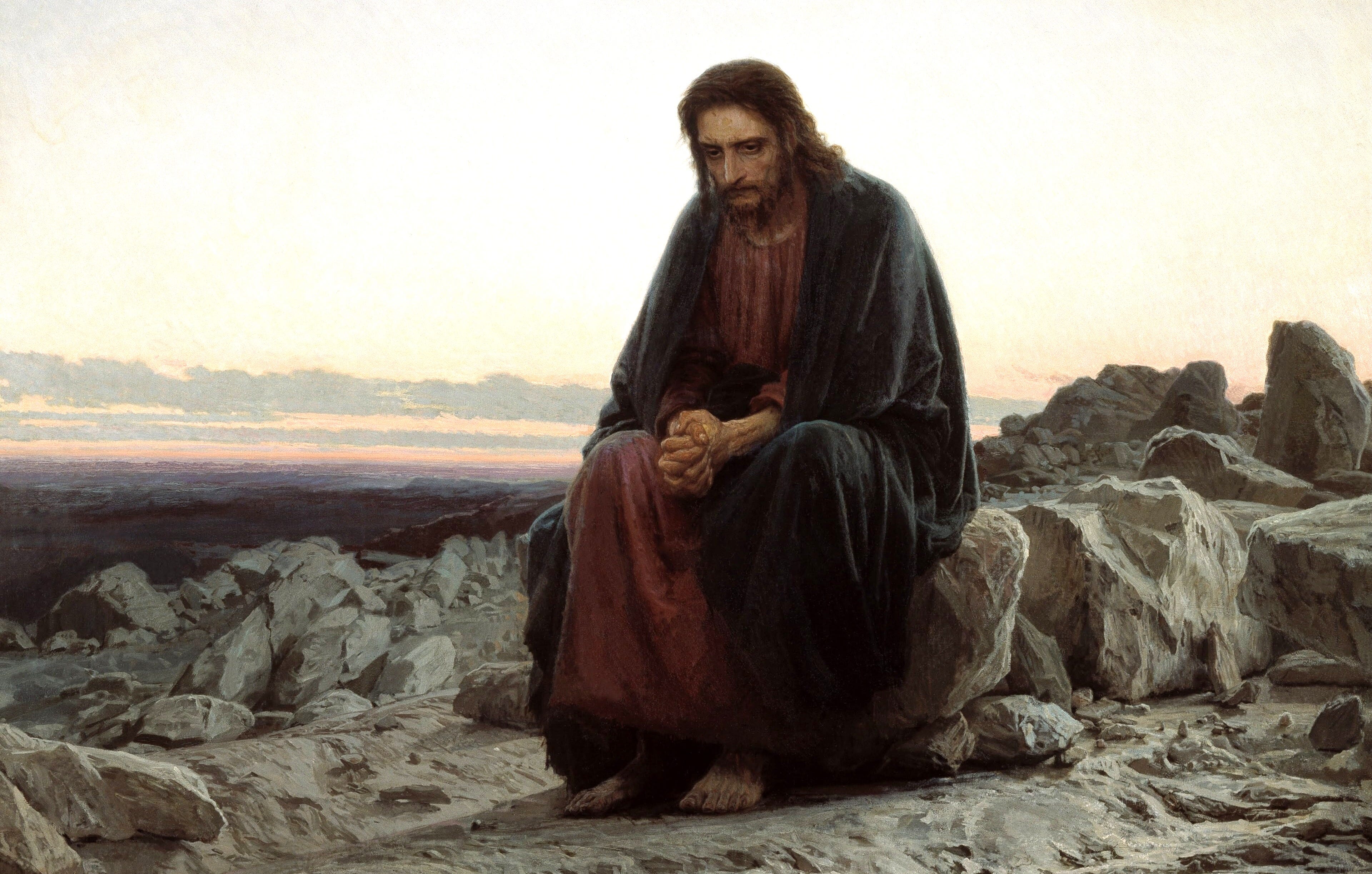
It was a sign that something special was about to happen – the inauguration of the Messianic Kingdom.
Editor’s Notes
The Gospel of the First Sunday of Lent recounts Christ’s forty days in the wilderness, fasting and being tempted by the Devil. This takes place immediately after Christ’s baptism by St John the Baptist, and precedes the beginning of his public ministry.
Having previously given Fr Coleridge’s account of how this extended incident constitutes Christ’s victory over the Devil – and the under-appreciated aspect of the angels coming to minister to Our Lord – let us return to the beginning, and hear why he went into the desert in the first place.
Fasting of Our Lord
The Ministry of St. John the Baptist
Chapter VI
St. Matt. iv. 11; St. Mark i. 13; St. Luke iv. 13.
Story of the Gospels, § 18
Burns and Oates, London, 1888
Headings and some line breaks added.
Sung on First Sunday of Lent
Our Lord ‘driven’ into the desert
Immediately after the great mystery of His Baptism, our Lord, as the three Evangelists tell us, entered into the desert, and was there tempted by the devil.
The language used by the Evangelists is very remarkable, inasmuch as they all expressly state that this withdrawal into the desert was made under the special direction of the Holy Ghost, Who guided the Sacred Humanity of our Blessed Lord in all the steps of His Life in accordance with the will of His Eternal Father. St. Matthew tells us that Jesus ‘was led into the desert by the Spirit;’ St. Mark uses a stronger word, and says that immediately ‘the Spirit cast Him forth’ into the desert, and St. Luke says that our Lord returned from the Jordan full of the Holy Ghost and was ‘driven by the Spirit’ into the wilderness for forty days and forty nights.
As there never was a time at which the blessed Soul of our Lord was not under the special direction of the Holy Ghost, it is natural to suppose that it is meant that on this occasion, as on others when similar language is used, some very extraordinary instinct suggested this particular step, which might not have been taken but for that instinct.
Prudential reasons for withdrawal
Many reasons may be assigned, in harmony with the usual dictates of Christian prudence, why, at this conjuncture, our Lord should have retired from the Jordan. He was about to begin His great work as the Teacher of mankind, and He had inaugurated it, as we may say, by a very signal act of humility in seeking for baptism at the hands of St. John, as has been seen in the foregoing chapter.
But as was so often the case, this self-humiliation had been met and crowned, in the Providence of His Father, by a far more signal exaltation, for the heavens had been opened to Him, the Holy Ghost had descended and remained upon Him, and the voice of His Father had been heard, declaring Him to be the Son of His love and predilection.
After this, it was natural for our Lord, in His constant practice of the most exquisite and consummate humility, to wish to withdraw from a spot in which He had no longer any occasion to remain, and where so striking a manifestation of His dignity and excellence had been made.
Such must also have been His desire for the sake of the Apostolical Life which He was now beginning and founding for those who were to come after Him, for which nothing can be more injurious or dangerous than applause, honour, and the like, so that Apostolic men are ever desirous to leave the spots where they have had great success, unless indeed, it is for the greater glory of God and greater service to souls that they should remain there.
Fasting and prayer as a preparation for His Ministry
Again, our Lord may have now desired to commence His active life by a long season of rigorous fasting, of uninterrupted prayer and communion with His Father, for which purpose no place could be better fitted than the wilderness into which He retired.
Certainly, there can be no doubt that the long years of the Hidden Life had been years of preparation and forecasting to the Sacred Heart of our Lord, as to the work which He came to do and the kingdom which He was commissioned to found. Still, as we have considered the mystery of the Baptism as the solemn inauguration of our Lord in His mediatorial office, as the beginning and foundation of the new order of things which was to arise from the Incarnation, it is natural to see in the retirement for the purposes of prayer and fasting which immediately followed it a more special devotion of Himself on the part of our Lord to immediate preparation for the work which He was now actually to take in hand.
There was another period like to this in our Lord’s sojourn upon earth before His Ascension, a period also of forty days, during which His main occupation, as far as it is revealed to us, was the consoling, strengthening, and conversing with the friends whom He was to leave behind Him to carry out the work of the foundation of His Church, and ‘speaking of the kingdom of God.’
There may perhaps have been something parallel to His occupation in those last forty days, in the preparation for the immediate work of the three years of His Public Life which our Lord may be thought to have made during the forty days’ retirement in the wilderness, when, however, He was conversing with His Father alone, and negotiating, if we may use an expression found in some holy writers, the great business of His preaching, the formation of His disciples, His miracles, His dealings with and attitude towards the authorities at Jerusalem and the people at large, as well as with those single souls whom He already counted as His own, whom His Father was to draw to Him, and of whom He was to make the future princes and apostles of His kingdom.
We shall find our Lord more than once retiring, in the midst of His active work, to spend the night in ‘the prayer of God,’ as the Evangelist calls it, and these occasions are usually connected with the taking of some step in advance in the formation of His Church, the foreshadowing of some great sacrament, and the like.
Examples in the Old and New Testament
And here again we may see that our Lord would also desire to set an example of such retirement and preparation to those who were to follow Him in the same sort of work for God, as Moses and Elias had shared in the same work in their day, and prefigured His fast and solitude.
In the Old Testament, as well as in the history of the Church, those have been the most powerful instruments for good in the work of the conversion of souls or of the advancement of the glory of God in other ways, who have spent a long time in retirement, and who come forth from the wilderness or the cloister fresh, as it were, from long solitude, penance, and prayer.
Such was the training even of St. Paul, who spent three years in Arabia before he began his Apostolic career, such that of St. Benedict and St. Ignatius, and of thousands of others who have followed in the footsteps of our Lord in this respect, and it may be fairly said that no activity, in the way of preaching or working, no close and familiar dealing with the souls of men, have any real strength, or stability, or blessing, unless they be well founded on that union with God and that elevation above earthly things which are the fruits of long solitary and penitential prayer, and unless, either virtually or actually, they are prepared beforehand.
Fasting of Our Lord
Read Next:


Did the Church intend to abolish fasting—or modify it? Newman Explains
One psychological challenge of fasting today—and ways to beat it
Here’s why you should subscribe to The Father Coleridge Reader and share with others:
Fr Coleridge provides solid explanations of the entirety of the Gospel
His work is full of doctrine and piety, and is highly credible
He gives a clear trajectory of the life of Christ, its drama and all its stages—increasing our appreciation and admiration for the God-Man.
If more Catholics knew about works like Coleridge’s, then other works based on sentimentality and dubious private revelations would be much less attractive.
But sourcing and curating the texts, cleaning up scans, and editing them for online reading is a labour of love, and takes a lot of time.
Will you lend us a hand and hit subscribe?
Follow our projects on Twitter, YouTube and Telegram:
Twitter (The WM Review)