

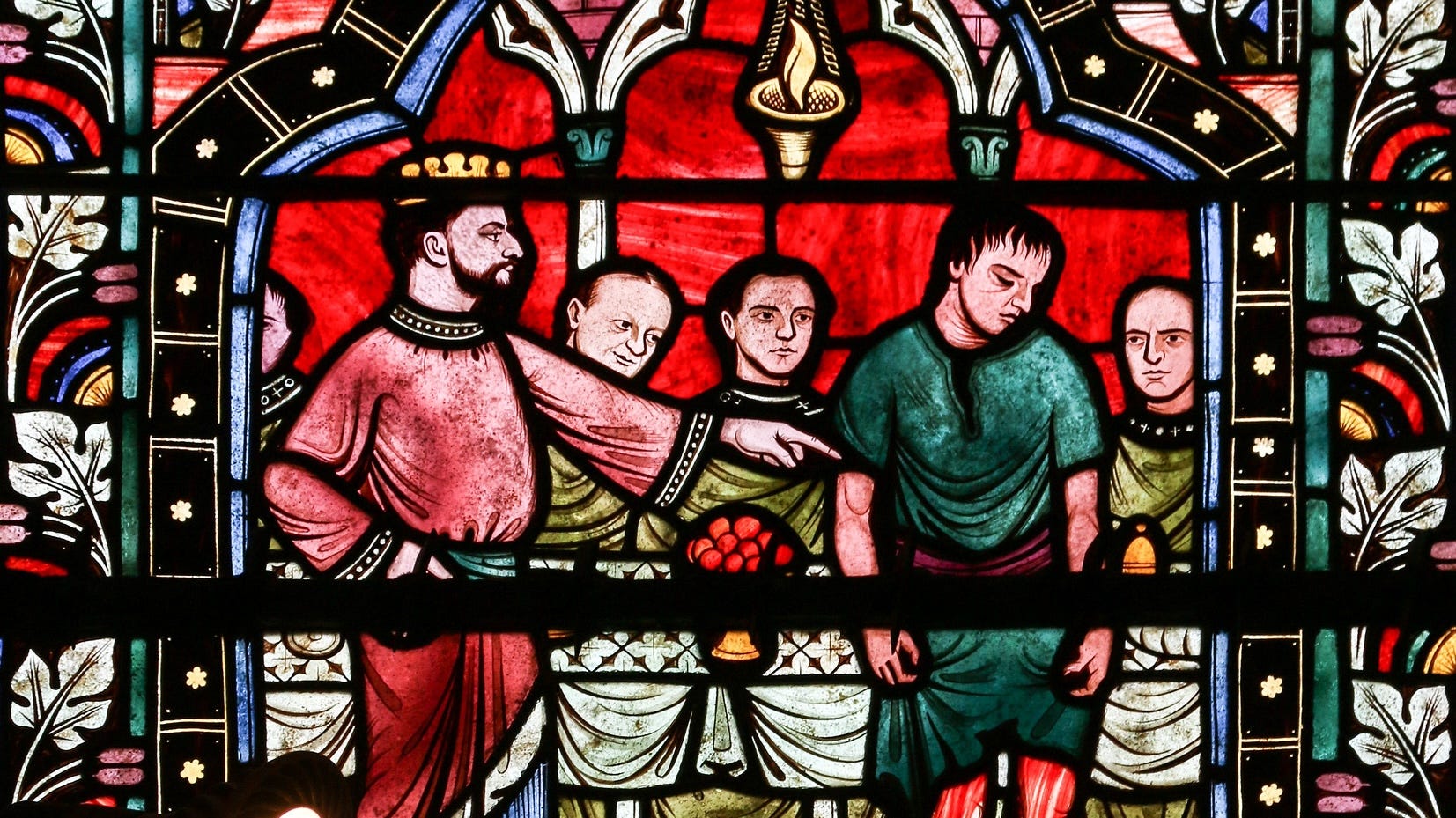
Who are the first guests, why did they refuse to come, and why did they kill the messengers? Why did the king burn their city, and what is the wedding garment?
Editor’s Notes
The following commentary deals with the Gospel read on the 19th Sunday after Pentecost.
Delivered in Holy Week, after Christ’s triumphal entry and His denunciation of the Pharisees. The chief priests had just withdrawn in anger after the parables of the Two Sons and the Wicked Husbandmen.
Our Lord reveals the rejection of Israel and the calling of the Gentiles, warning that even those admitted to His Church must retain the “wedding garment” of faith and obedience. The parable, which is a development of that of the great banquet, moves from the sentence upon the Jewish nation to the moral conditions of belonging to the new Kingdom.
It marks a transition from judgment to instruction – Christ discloses both the generosity and the severity of the Gospel. The new covenant is universal, merciful, and regal, yet demands much from its subjects. For the faithful, it is a warning that outward profession without inward disposition ends in exclusion.
In this part, Fr Coleridge tells us…
How our Lord’s teaching turns from judgment to instruction, after the chief priests withdraw in anger and fear.
That He now reveals the transfer of the Kingdom from the rejected Synagogue to a new people—the heirs of Abraham by faith.
Why His next parable, the Wedding Feast, raises the dignity of the Gospel call and warns of royal justice within divine mercy.
He shows us that the rejected priests depart, but the King remains—laying the foundations of His new and universal Kingdom.
The Wedding of the King’s Son
Passiontide, Part I
Chapter VI
St. Matt. xxii. 1-14; Story of the Gospels, § 137.
Burns and Oates, London, 1886.
(Read at Holy Mass on the Nineteenth Sunday after Pentecost)
The priests retiring
We have seen that after the parables of which we have lately spoken had been delivered by our Lord, the Chief Priests had left Him in indignation. They had discerned plainly enough the intention with which those parables had been spoken. At the same time, they could not help fearing for themselves if they made any open attempt upon Him in the presence of the people.
We may suppose, then, that He was left by them in comparative peace for the rest of the time which could be given to teaching on that day, and that He employed it, as was His wont, in instructing the people in the Temple. His teaching would thus fall back on to its usual lines, though it would to some extent be modified in character by the circumstances of the time and occasion on which He was teaching. It must be remembered, then, in studying the parable now before us, how momentous that time and that occasion were.
The parable which had just been delivered had conveyed to the priests with very little ambiguity indeed, the truth that the Jewish Synagogue was now rejected by God; that the Kingdom of God, that the system in which the true religion, the promises, the hopes of the human race, were all bound up, and through which the special means of grace belonging to that religion had been opened to the faithful was now to be transferred to another people, who were to become the true children of Abraham and heirs of the blessings allotted to his race.
And this solemn sentence had been pronounced in the Temple itself, by the King who had lately entered it in triumph in the name of the Lord, amid the Hosannas of the multitudes. It had been communicated to the Chief Priests, as the representatives of the holy nation, and had been understood by them almost in its full significance. Moreover, the solemnity which had taken place in the Temple had been an offering to God on the part of our Lord of Himself as the Victim for the Redemption of the world, in the sacrifice which was so speedily to be consummated on the Cross.
Under such circumstances, the teaching of our Lord in the Temple assumed a new character. He had not simply to declare the annulling of the former and figurative system, but to lay down the principles and conditions of the new order of things which was to succeed in its fulfilment to the Old Law.
That system was to be wide, and large, indulgent, full of mercy and grace, of life and spirit, it was not to be exclusive or severe, or hard in its requirements and obligations, its yoke was to be light, and its burden sweet, and yet, with all these elements of condescension, it was a Kingdom, the system of a King, and, as the Parable of the Wicked Husbandmen had set forth the chastisement of those who had been disobedient under the former system, so there was to be in the new system a royal way of dealing with the presumptuous and disobedient.
Our Lord continues his teaching
The teaching of the parable which immediately follows in the first Evangelist seems exactly to correspond to these conditions under which our Lord was now speaking.
It is not one of those which were directly addressed to the Chief Priests, as distinct from the people. At the same time, it seems to refer to the Parable of the Wicked Husbandmen which had just been delivered, in a manner which shows that the particular lesson of the former was still before our Lord’s mind as important to all. The people seem to have been present as well as the Chief Priests when the former was spoken. But the reference to the chastisement of the Wicked Husbandmen is here only introduced in a parenthetic manner.
The more important part of the parable is probably the concluding section, for the sake of which it was perhaps spoken on this occasion, and this section requires the former portion as its foundation. It is also remarkable that the parable before us is in some degree a repetition of that of the Great Supper, which St. Luke places at an earlier stage of our Lord’s teaching. That is, the substance is the same in both parables, though there are many important changes, as might be expected from the circumstances of the time.
The Parable of the Great Supper had not, as far as we know, been delivered in public. It was spoken by our Lord when He was in the house of the friendly Pharisee, and therefore to a comparatively limited audience.1 Above all, it was not spoken after our Lord had assumed, what we may call the character of judge. We shall point out the variations which our Lord introduced, now that He was speaking to the people collected in the Temple, after the beginning of the Week of His Passion, and then give a short commentary on this its second version, as it may be called.
Parable of the Wedding Feast
‘And Jesus answering, spoke again in parables to them, saying, The Kingdom of Heaven is likened to a King, who made a marriage for his son.’ In the former parable, it is only, ‘A certain man made a great supper and invited many.’ The circumstances are therefore raised in dignity—the man becomes a king, and the feast is not merely a great supper, but a wedding feast for the son of the king.
‘And he sent his servants to call them that were invited to the marriage, and they would not come.’ This summoning of the guests who had been invited at the time of the feast itself, seems to belong to the customs of the Oriental nations. In this parable, it is merely said that the guests would not come. In the former parable, we are told that ‘they began at once to make excuse’—and the excuses are given in detail.
‘The first said, I have bought a farm, and must needs go out and see it, and another said, I have bought five yoke of oxen, and I go to try them, and another said, I have married a wife.’ This last says, ‘Therefore I cannot come,’ and the others each begged to be excused. In the present parable, although it is a king who invites them on so special an occasion, there are no excuses made, but there is a simple refusal to come.
Another very significant difference is that in this later version of the same narrative, the King, notwithstanding his dignity, condescends to send again to pray the guests to come, whereas in the former it is never open to those who have once refused to regain their opportunity.
‘Again he sent other servants, saying, Tell them that were invited, Behold, my beeves and fatlings are killed, and all things are ready, come ye to the wedding. But they neglected, and went their ways, the one to his farm, and another to his merchandise.’ Nor is it simply a case of neglect.
‘And the rest laid hands on his servants, and having contumeliously treated them, put them to death.’ This then is something entirely new, as far as the comparison between the two parables is concerned, and it appears, as we have said, to be a reminiscence of what has been lately said by our Lord in the Parable of the Wicked Husbandmen.
And it is followed by another entirely new feature, in keeping with it, for our Lord adds, ‘But when the King had heard of it he was angry, and sending his armies he destroyed those murderers and burnt their city.’ These details would have been out of place in the former parable, where the host, whose invitation had been slighted, is a simple individual without authority or power.
It is only said there that the master of the house was told of these things, that is, of the excuses of the invited guests, and was angry at it—so much as to declare that none of those who were invited should taste of his supper. The vengeance in the later parable is quite in keeping with the kingly character of the host, in consequence of which the rudeness of the guests in the former parable becomes an insult to authority and a disloyalty in the parable now before us.
The sequel to the refusal of the guests is more fully drawn out in the parable in St. Luke than in that before us. There the master of the house says to his servant, Go out quickly into the streets and lanes of the city, and bring in hither the poor and the feeble and the blind and the lame. And the servant said, Lord, it is done as thou hast commanded, and yet there is room. And the Lord said to the servant, Go out into the highways and hedges, and compel them to come in that my house may be filled. But I say unto you, that none of those men that were invited shall taste of my supper.
In the present parable, there is one sending out into the highways and no more. ‘Then saith he to his servants, The marriage is ready, but they that were invited were not worthy. Go ye therefore into the highways, and as many as ye shall find, call to the marriage. And his servants going forth into the ways, gathered together all that they found, both bad and good, and the marriage was filled with guests.’
A new part added
We now come to the last portion of the parable before us, which is entirely new and has no counterpart in the former. ‘And the king went in to see the guests, and he saw there a man who had not on a wedding garment. And he said to him, Friend, how camest thou in hither, not having on a wedding garment? But he was silent. Then the king said to the waiters, Bind his hands and feet and cast him into the exterior darkness—there shall be weeping and gnashing of teeth.’
‘For,’ our Lord adds, ‘many are called, but few are chosen.’ This then is what we gather from a comparison between the two parables, and we have now to explain the several truths which may be found set forth in them.
We need make but little question that the banquet to which the guests are here invited is the feast on the Gospel blessings, which is set forth by God in the Church. This involves, for those who enjoy it lawfully and profitably, the further banquet on the ineffable blessings of the Heavenly Kingdom.
But it is something present, which is to be accepted and entered upon here and now, as is evident, if from nothing else, from the exclusion of the unworthy guest, and the declaration with which our Lord concludes His teaching, that the called are many, but the chosen or elect few. In the former parable our Lord had spoken to the guests at an entertainment to which He was Himself invited, and when one of those present had been apparently so moved by His gracious conversation that He could not refrain from exclaiming, ‘Blessed are they that shall eat bread in the Kingdom of God!’
Here there was no such invitation to speak. But our Lord seems to have desired to teach the privileges of the Gospel banquet, and He does so in language which goes beyond what He had before used, both, as has been pointed out, in the matter of the magnificence of the occasion, for it is the wedding of the king’s son of which He now speaks in which all the guests seem to have been provided, or to have provided themselves with fitting robes, and in the obligatory character of the invitation on those who had received it.
Comparison with the former parable
Thus, then, in the earlier parable there is no punishment beyond the exclusion from the banquet for those who were so foolish as to despise it, and when they did so it seems to have been with a certain air of liberty and equality between themselves and their inviter which is altogether wanting in the later parable. There would be something rude in saying to a king, ‘I pray thee hold me excused,’ on account of ordinary employments.
Our Lord then adds this further line to the teaching which He had already delivered, by making it the command of a sovereign which is neglected or despised. This teaching implies the truth that the acceptance of the Gospel privileges is obligatory, although it is left within the power of the human will to turn away from them when they are brought home to it, for we are responsible to our Maker and Judge for the choice which we make, although He does not now force us to make the choice that is right.
For we are His creatures and belong to Him by an absolute dominion, which has no parallel in creation, and we have no right, though we have the power, being free, to disobey His commands, even if they were hard and unprofitable to ourselves. On the other hand, we see in the comparative magnificence of the banquet in this last parable some allusion to the truth that now, after the Day of Palms, on which the great Sacrifice of our Lord was practically and formally begun, He speaks of the wedding feast of the King’s Son, and seems to invite our thoughts to dwell on all the riches and splendours of grace that are laid before us in the Church, all of them flowing from and being applications of the fruits of that Sacrifice.
Advance in doctrine
We seem to see a further advance in the doctrine of this parable over that of the former, in the measure that is dealt out by the great justice of God to those who decline His invitation, and thus put themselves in the position of rebels against Him.
It seems a strange thing that persons invited in the way here mentioned, and to so great an honour and blessing as the sharing in the wedding supper of the son of a king, should not only neglect the invitation and treat it with indifference, but should go on further to heaping insult and contumely on the messengers, and even still further, to the putting them to death. There is nothing of this kind in the former parable.
There the neglectful guests allege the excuses that have been mentioned, and these are so framed by our Lord as to embrace the three great concupiscences, which are the springs in human nature of everything that debases and degrades it, and turns away the mind, which is given to man to feed on the things of God, down to the lower pleasures and the interests and ambitions of this world.
A feature from the Wicked Husbandmen
In the second parable our Lord takes a feature from the Parable of the Wicked Husbandmen, and adds it to the picture as drawn before. The great work of Redemption has been begun, the time is come for the Passion of the Son of Man by which that Redemption is to be wrought. The message which invites mankind to share in the Gospel feast necessarily includes the acceptance of the Gospel revelation of the great mercies of God through Jesus Christ and Him Crucified.
It involves the obligation of obedience to His Law and the following of His example, as well as the enjoyment of the privileges won by the Precious Blood. It involves, therefore, faith, submission, obedience, humility, mortification, penitence, a life above the world, a trampling on all that the world and the flesh hold dear. It is a message, therefore, which the natural man hates, which the world abhors and makes war upon, because its own fallacies and impostures are exposed thereby.
So it is true, in the actual history of which this parable is the figure, that the messengers of the great King are not only disregarded and neglected, but insulted, ill-treated, or even slain. And now that our Lord has just spoken of the execution of the terrible sentence upon the Jewish nation for the guilt which it was to incur by His own murder, it is natural that He should no longer hold back this truth, even though, under other circumstances, it might have seemed out of place in this parable.
He adds, therefore, both the circumstance of the ill-treatment and murder of the messengers of God, deputed to bring to men the glad tidings of their salvation, and also the judgment that would fall on those who so dealt with them, in their temporal punishment even in this world. This seems to be the explanation of the King sending his armies, destroying the murderers, and burning up their cities.
Warning conveyed
The direct course of the parable is interrupted by our Lord for the purpose of introducing the outrages inflicted on the messengers of the King as well as the punishment of the offenders. It looks at first sight as if this might be merely a reminiscence of the Parable of the Husbandmen, inserted by our Lord for the sake of connecting the two in the minds of the hearers.
But we can see that it is not merely a reminiscence. It is also a warning. And it will surely be wisdom not to pass over this lesson in considering this parable, not to forget to call to mind the truth that the good message of the Gospel, with all its graciousness and beauty, its fair promises of ineffable happiness and strength and recompense, must always find in us, as long as we are in the flesh, something which is stirred up by it to hostility and rebellion.
For it is not only a message which nature does not care for, as something spiritual and too high for us, but also which speaks with authority and enjoins obedience, and implies mortification of all that is natural in submitting to it, and threatens, moreover, chastisement if we do not yield it obedience. To strive against the stream of the world while we are in it, and to fix our gaze on the things which are heavenly and eternal while we are beset by the things of sense, which pass away—this requires an effort and a continuance of exertion by which our natural feebleness and inconsistency, our need of novelty and variety, are overtasked.
And if our Lord seems to go out of His way to introduce this feature in His teaching, still it is in truth a necessary feature in any accurate picture of our present condition. Our Lord is preparing us beforehand for the feature of the ‘man without a wedding garment.’ There is therefore something more than a history of the past in the chastisement of these first offenders against the King, who refused his invitation.