

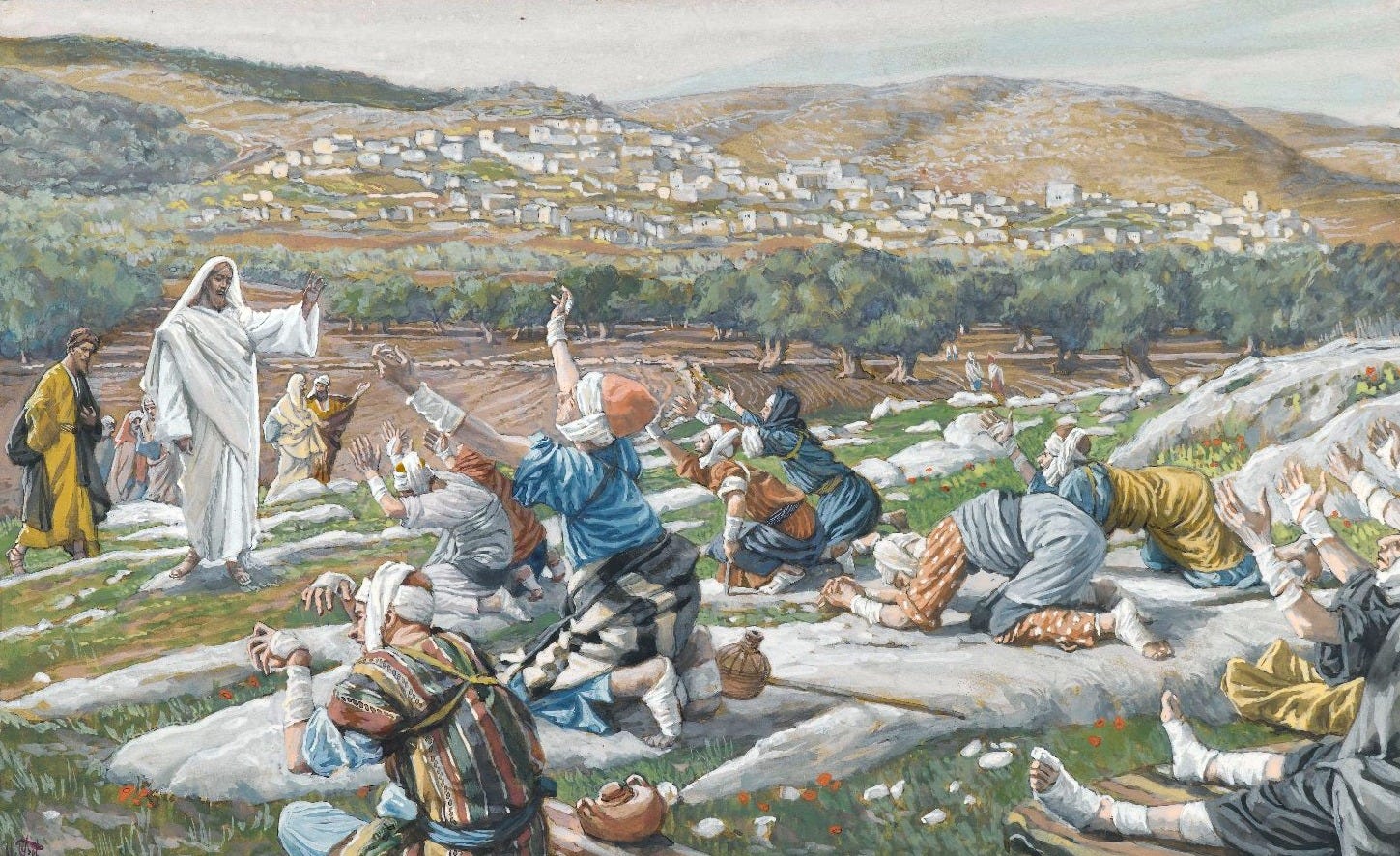
Only one the the ten returned to thank Our Lord – and he was a ‘foreigner’, not of the Chosen People. What are we to learn from this?
Editor’s Notes
On the Thirteenth Sunday after Pentecost, the Church reads the account of Our Lord healing the ten lepers.
“At that time, Jesus was going to Jerusalem, He was passing between Samaria and Galilee. And as He was entering a certain village, there He met ten lepers, who stood afar off and lifted up their voice, crying, Jesus, Master, have pity on us. And when He saw them He said, Go, show yourselves to the priests.
“And it came to pass as they were on their way, that they were made clean. But one of them, seeing that he was made clean, returned, with a loud voice glorifying God, and he fell on his face at His feet, giving thanks; and he was a Samaritan. But Jesus answered and said, Were not the ten made clean? But where are the nine? Has no one been found to return and give glory to God, except this foreigner?
“And He said to him, Arise, go your way, for your faith has saved you.”
But Fr Coleridge’s exposition of this incident falls in a chapter which also deals with other events in this part of St Luke’s Gospel.
Here are the preceding verses, to which Fr Coleridge also refers:
“And he said to his disciples: It is impossible that scandals should not come. But woe to him through whom they come! It were better for him that a millstone were hanged about his neck and he cast into the sea, than that he should scandalize one of these little ones. Take heed to yourselves. If thy brother sin against thee, reprove him: and if he do penance, forgive him. And if he sin against thee seven times in a day, and seven times in a day be converted unto thee, saying: I repent: forgive him.
“And the apostles said to the Lord: Increase our faith. And the Lord said: If you had faith like to a grain of mustard seed, you might say to this mulberry tree: Be thou rooted up and be thou transplanted into the sea. And it would obey you.
“But which of you, having a servant ploughing or feeding cattle, will say to him, when he is come from the field: Immediately go. Sit down to meat. And will not rather say to him: Make ready my supper and gird thyself and serve me, whilst I eat and drink; and afterwards thou shalt eat and drink Doth he thank that servant for doing the things which he commanded him. I think not. So you also, when you shall have done all these things that are commanded you, say: We are unprofitable servants; we have done that which we ought to do.”
These teachings and miracle take place in the late Judæan/Peræan phase of Our Lord’s ministry, which ended in his final journey to Jerusalem and to the Passion. At this time, Our Lord intensifies his formation of the Apostles and the others who followed him.
After the other topics in the chapter, Fr Coleridge reaches St Luke’s account of the healing of the lepers, which provides him with the opportunity to discuss the importance of gratitude in the Christian life.
Various Teachings and Counsels
The Preaching of the Cross, Vol. III
Chapter I
St Luke xvii. 1–19
Story of the Gospels, § 117, 118
Burns and Oates, London, 1888
Thirteenth Sunday after Pentecost
Part 0: The final stage of Our Lord’s pre-Passion ministry

As the Passion approaches, Our Lord intensifies his formation of the Apostles, preparing them for the kind of lives they will have to lead when they are sent to teach, govern and sanctify the Church.
Part I: Why scandals are inevitable – and are especially evil in the clergy

No-one should be more afraid of causing scandal than those in Holy Orders, Fr Coleridge says.
Part II: The power of faith in seemingly impossible situations

The Christian life is as arduous as uprooting a mulberry tree – made possible by supernatural faith.
Part III: Even the best are ‘unprofitable servants’ – and this is a source of joy

We have an unpayable debt to God, as he made us and holds us in existence.
Part IV: What are we supposed to learn from Jesus healing the ten lepers?
Only one of the ten lepers returned to thank Our Lord.
Here’s why you should subscribe to The Father Coleridge Reader and share with others:
Fr Coleridge provides solid explanations of the entirety of the Gospel
His work is full of doctrine and piety, and is highly credible
He gives a clear trajectory of the life of Christ, its drama and all its stages—increasing our appreciation and admiration for the God-Man.
If more Catholics knew about works like Coleridge’s, then other works based on sentimentality and dubious private revelations would be much less attractive.
But sourcing and curating the texts, cleaning up scans, and editing them for online reading is a labour of love, and takes a lot of time.
Will you lend us a hand and hit subscribe?
Follow our projects on Twitter, YouTube and Telegram:
Twitter (The WM Review)