


We could even call it the ‘parable of parables’, as it holds the key to all the rest.
Editor’s Notes
Our Lord told the Parable of the Sower, read on Sexagesima Sunday, early in His public ministry, when He began to teach in parables more frequently. It is the first recorded parable in the Gospels.
It follows growing opposition from the Pharisees and the rejection of His teachings by many, prompting His shift to parabolic instruction.
Shortly after, He explained the meaning of this and other parables to His disciples, emphasising the mysteries of the Kingdom of God. He also explained that he was using this manner of teaching both to reveal truths to those who are disposed to receive them, and to conceal them from the hardened-hearted.
Part I: How does the Parable of the Sower unlock all Christ’s other parables?
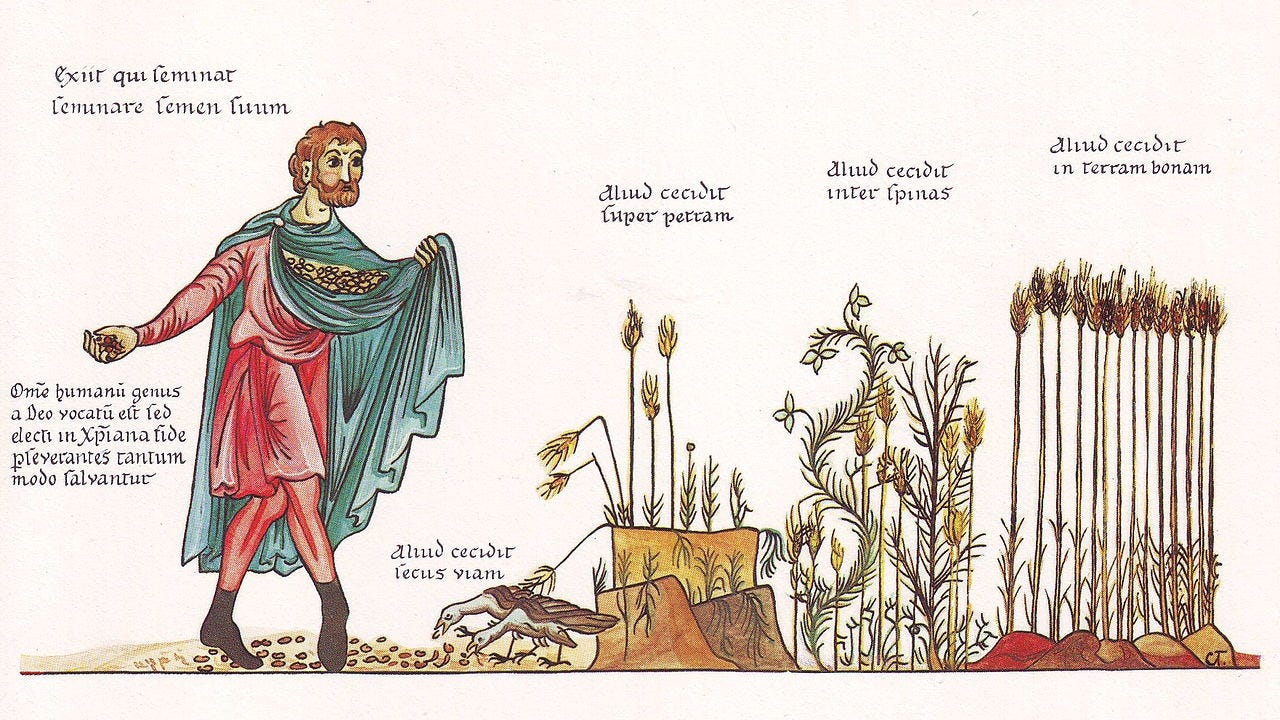
In the first part, Fr Coleridge gives an overview of the parable: it illustrates how different hearts receive or reject divine truth – and sets the tone for the future of the Apostles’ ministry after Pentecost. More than this, it provides the key for understanding how and why Christ began, at a certain point, preaching in parables.

Part II: How do the birds reveal a brutal war for the soul in the Parable of the Sower?

Tiredness or distraction in prayer isn’t always a natural phenomenon. Fr Coleridge explains how Satan works to snatch away the seed before it can sprout – and how to avoid this happening to us.

Part III: What if your faith is shallow, and you won’t know until it’s too late?
The Parable of the Sower teaches us that while hardships can strengthen some, they destroy those whose faith is based on stony ground or suffocated by thorns.

Part IV: What makes for good soil in Christ’s Parable of the Sower?

After seeing the three ways in which the seed is prevented from developing as it should, Christ’s Parable shows us the conditions for receiving the Word of God and yielding fruit.


Here’s why you should subscribe to The Father Coleridge Reader and share with others:
Fr Coleridge provides solid explanations of the entirety of the Gospel
His work is full of doctrine and piety, and is highly credible
He gives a clear trajectory of the life of Christ, its drama and all its stages—increasing our appreciation and admiration for the God-Man.
If more Catholics knew about works like Coleridge’s, then other works based on sentimentality and dubious private revelations would be much less attractive.
But sourcing and curating the texts, cleaning up scans, and editing them for online reading is a labour of love, and takes a lot of time.
Will you lend us a hand and hit subscribe?
Follow our projects on Twitter, YouTube and Telegram:
Twitter (The WM Review)
Blessings and appreciation from Sydney Australia.