

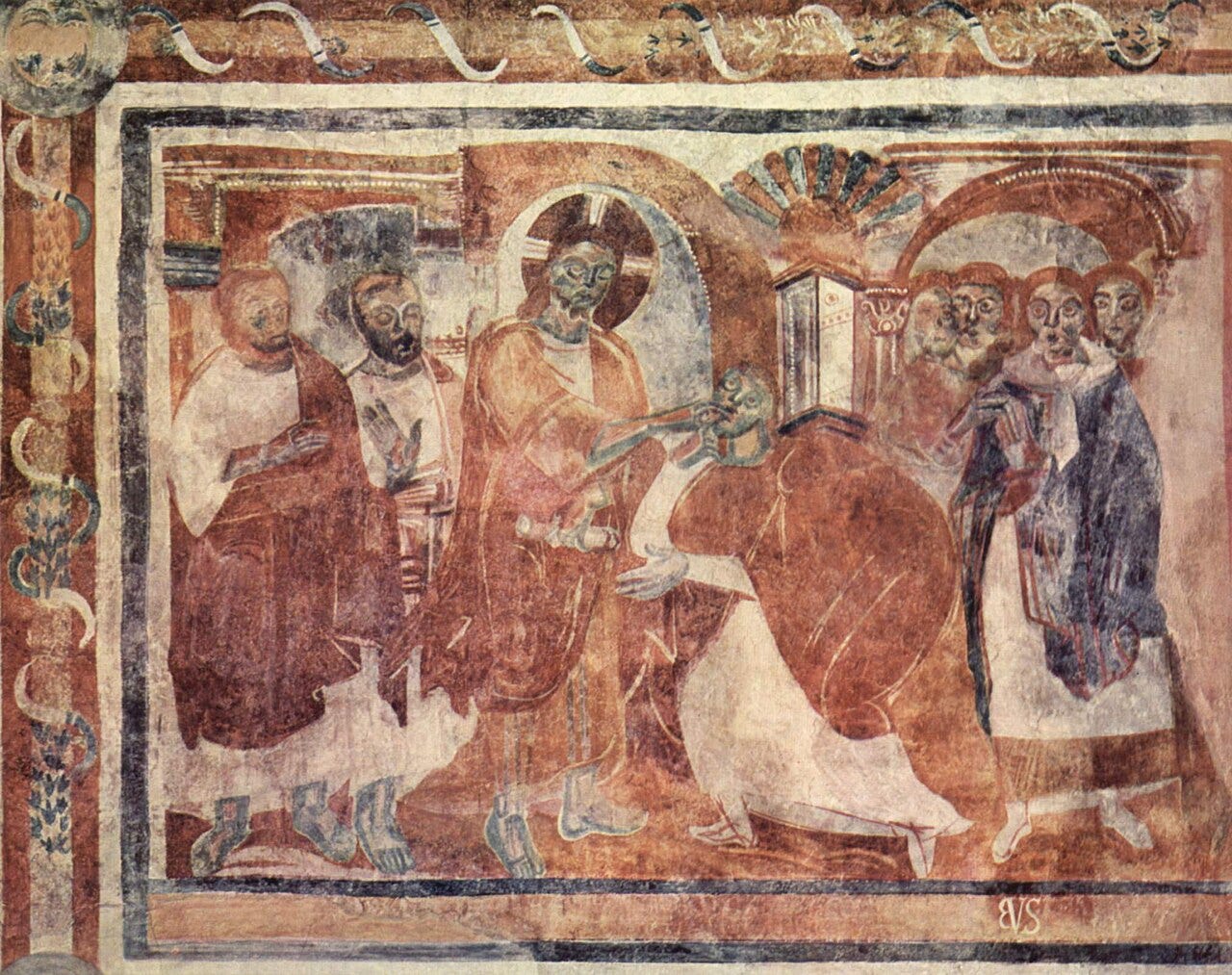
A crucial event in the life of every Christian baptised in the traditional rite – the ‘Ephpheta’ – and when Our Lord first set these words.
Editor’s Notes
On the Eleventh Sunday after Pentecost, the Church reads Our Lord’s healing of the deaf and dumb man.
At that time, Jesus departing from the district of Tyre came by way of Sidon to the sea of Galilee, through the midst of the district of Decapolis. And they brought to Him one deaf and dumb, and entreated Him to lay His hand upon him. And taking him aside from the crowd, He put His fingers into the man’s ears, and spitting, He sighed, and said to him, Ephpheta, that is, Be opened. And his ears were at once opened, and the bond of his tongue was loosed, and he began to speak correctly. And He charged them to tell no one. But the more He charged them, so much the more did they continue to publish it. And so much the more did they wonder, saying, He has done all things well. He has made both the deaf to hear and the dumb to speak.
This miracle takes place towards the end of the period Fr Coleridge calls “the training of the apostles,” and before that in which Our Lord’s preaching becomes more focused on the Cross. It is immediately preceded by the healing of the Syrophœnician woman’s daughter, and followed by the second multiplication of loaves for the four thousand.
Taking place in the Gentile Decapolis, this miracle points to the Gospel’s reach beyond Israel. Coleridge explains how the incident is used to teach the Apostles the virtues of prudence and discretion in their ministry.
It is also a crucial event in the life of every Christian, in that the “Ephpheta” in the solemn rite of Baptism is taken from this event.
The Deaf and Dumb Healed
The Training of the Apostles, Vol. IV, Chap. XV
St. Mark vii. 31-37
Story of the Gospels, § 77
Burns and Oates, London, 1885
Read on the Eleventh Sunday after Pentecost.
Part I: What Christ’s seven steps in healing the deaf and dumb mean for Christians today
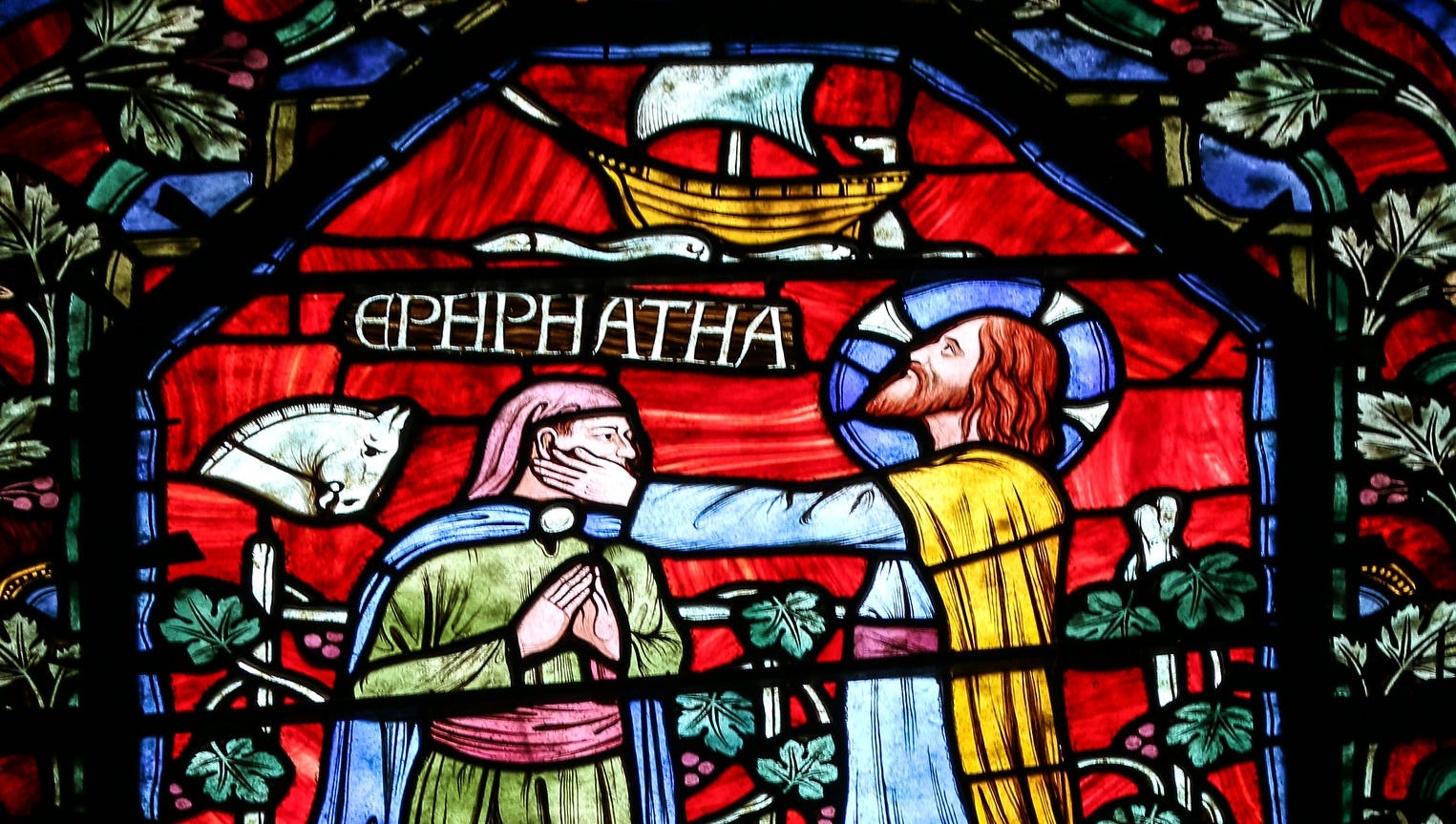
When Christ heals a deaf-mute, he uses seven preparatory acts, culminating in the ‘ephpheta’ – which the Church retains in Baptism today.
Part II: The link between the healing of the deaf-mute and the Agony in the Garden

Christ’s groan before healing the deaf-mute reveals the sorrow, humility and power behind every miracle – and the danger of misusing restored gifts.
Here’s why you should subscribe to The Father Coleridge Reader and share with others:
Fr Coleridge provides solid explanations of the entirety of the Gospel
His work is full of doctrine and piety, and is highly credible
He gives a clear trajectory of the life of Christ, its drama and all its stages—increasing our appreciation and admiration for the God-Man.
If more Catholics knew about works like Coleridge’s, then other works based on sentimentality and dubious private revelations would be much less attractive.
But sourcing and curating the texts, cleaning up scans, and editing them for online reading is a labour of love, and takes a lot of time.
Will you lend us a hand and hit subscribe?
Follow our projects on Twitter, YouTube and Telegram:
Twitter (The WM Review)