

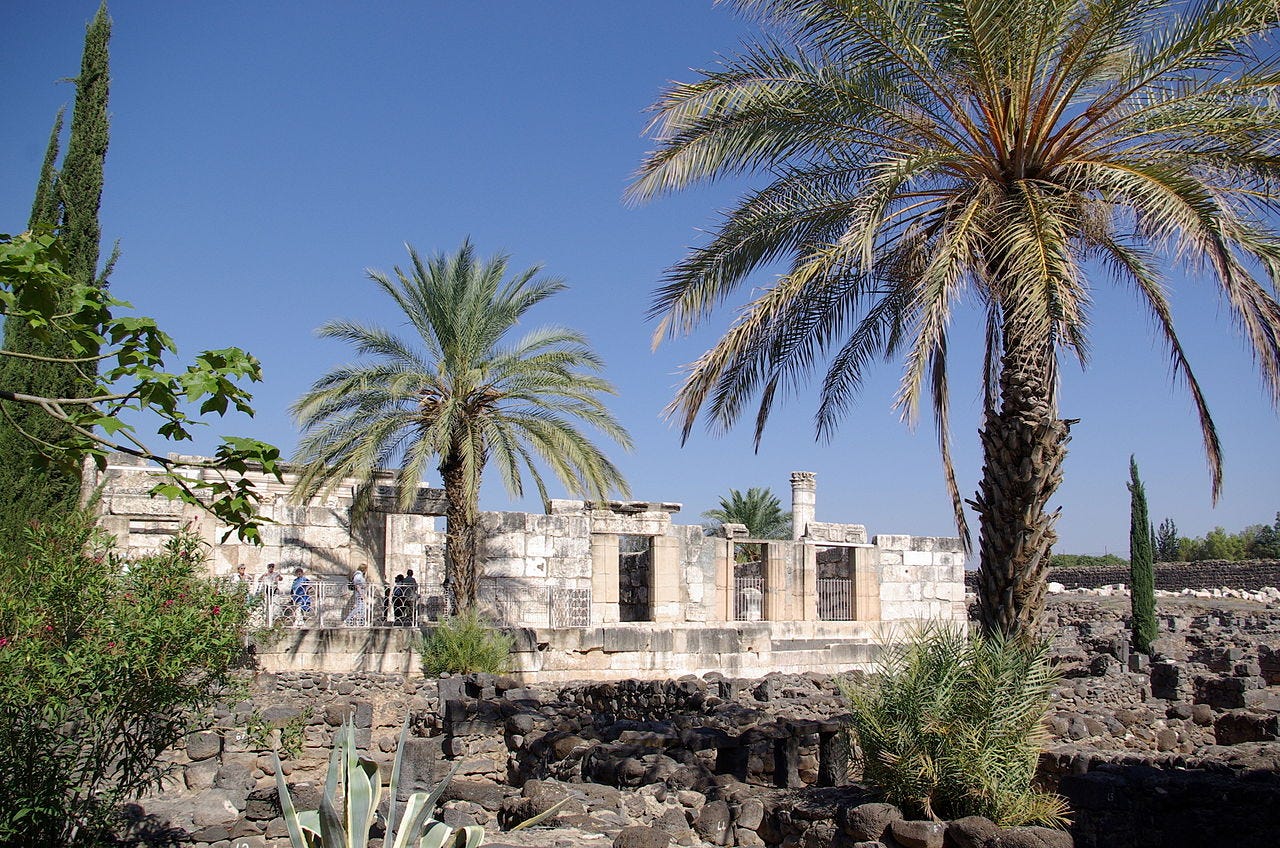
After months of preaching and absence, Christ’s return to Capharnaum becomes the setting for the centurion’s plea for his servant.
Editor’s Notes
The account of Christ’s healing of the centurion’s servant is read on the Third Sunday after Epiphany, in conjunction with that of the healing of the leper. St Matthew passes rapidly from the Sermon on the Mount and the healing of the leper to this miracle – but St Luke’s Gospel shows us that it took place in the second year of Our Lord’s Galilean ministry.
One of the chief significances of this miracle is that it foreshadows the calling of the Gentiles, and warns Israel against pride – and the risk of forfeiting privileges given by God.
It is intriguing that the words of the centurion so praised by Christ – “Amen I say to you, I have not found so great faith in Israel” – are repeated three times by the priest before his Holy Communion at Mass, and a further three times on behalf of the laity.
In his commentary on this piece, Father Coleridge tells us:
How Christ’s missionary circuits prepared the ground for the Centurion’s faith
That he taught through withdrawal and silence, as well as public preaching
Why His return to Capharnaum draws forth the centurion’s faith.
The Centurion’s Servant
From
The Training of the Apostles—Part II
Fr Henry James Coleridge SJ
1882, Ch. X
St. Matt. viii. 5–13; St. Luke vii. 1–10
Story of the Gospels, § 50
Third Sunday after Epiphany
Order of events
We now come to some incidents of this second year of our Lord’s preaching as to the date of which we have no precise guidance.
It has already been said that the Sermon on the Plain was probably delivered early in the summer, after the Pasch at which our Lord healed the impotent man at the Pool of Bethsaida in Jerusalem.
Close on this Pasch followed the return of our Lord to Galilee, and the league formed against Him by the ecclesiastical rulers with the political servants of the Tetrarch. It was a coalition of very incongruous elements, but it was clearly as much to the interest of Herod to suppress any movement by which the peace of the country might be endangered, as it was to the interest of the priests at Jerusalem to oppose the influence of One Who was certainly not of themselves. We have seen that our Lord retired before the coalition, and that He made at this time the selection of the twelve to be His Apostles.
The Sermon on the Plain then followed. And it is not a fanciful conjecture to place these two signal events about the time of the feast of Pentecost after the second Pasch.
The next great event in the preaching of our Lord was the return to Capharnaum, after which He began to teach the people by parables only—a change in His method which attracted the wonder and caused the inquiries of the disciples themselves.
This beginning of the teaching by parables is very probably to be placed about the time of the seed-sowing for the harvest of the next year, that is, in the later months of the year to which the events already mentioned belonged. This date is made probable by the subject of the first and succeeding parables. It was so very much our Lord’s habit to take the text, so to say, of His teaching from the natural objects and scenes around Him at the time, that we can hardly doubt that He chose the imagery of this first series of parables in this manner, and that the fields were actually being sown at the time at which He spoke.
If this be so, and if the Sermon on the Plain be rightly placed about the feast of Pentecost, it would follow that an interval of several months occurred, immediately after the delivery of that Sermon, and before the beginning of the parables.
During this interval we have little to guide us as to the exact dates of the few incidents which are recorded, though we may fairly trust the order in which they are arranged by the most historical of the Evangelists, St. Luke.
Our Lord on His missionary circuits
There is nothing in this that ought to be surprising to those who are, to some extent, familiar with the manner in which our Lord spent so much of His time during His Public Life.
We already know that He passed large portions of the most active part of His career in Galilee, and afterwards in Judea, in missionary circuits throughout the country, the events and occupations of which were very much the same day after day, except that He was constantly changing the scene of His labours. Periods of activity of this kind are in one sense most full of incidents of importance, for nothing can be more important in the history of the Kingdom of God than the conversion of souls, and these periods were in this respect most fruitful.
But in another sense they are marked by a great sameness, and the history which serves for one week or month would be almost equally suited to another. Thus it is not the custom of the Evangelists to speak of these circuits except in the most summary manner.
Our Lord again at Capharnaum
But it would often happen that the sameness of these periods would be broken by some remarkably striking incidents of mercy or power, and it is natural that such incidents should not be passed over in the sacred history.
They would be exceptional features in the general picture, for which, as such, a few words would suffice. Such are the few incidents which, as is clear from the order of St. Luke, belong to this period, that is, between the Sermon on the Plain and the delivery of the first great series of the Parables of our Lord.
The miracle of which we are now to speak was in some important respects singular and unprecedented in the Ministry of our Lord, and it was made by Him the occasion of a warning to some of those who were hanging back in their adhesion to Him, of which the Evangelists had afterwards many reasons for seeing the significance. We know that, even during the circuits of the first year of His Galilean preaching, our Blessed Lord was for long seasons together absent from Capharnaum, the place which, nevertheless, had gained the name of being His own city.
Much more was He likely to absent Himself from it for long intervals during this the second year of His preaching. But He would often have occasion to visit it from time to time. One of these visits was made, as St. Luke tells us, at the conclusion of one of the circuits of which we are speaking, and which is hinted at rather than directly mentioned in the narrative of the Evangelists. St. Luke says, ‘And when He had finished all His words in the hearing of the people, He entered into Capharnaum.’
Here it was that the occasion of the miracle was awaiting Him.
‘And the servant of a certain Centurion, who was dear to him, being sick, was ready to die. And when he heard of Jesus, he sent to Him the ancients of the Jews, desiring Him to come and heal his servant. And when they came to Him, they besought Him earnestly, saying to Him, He is worthy that thou shouldst do this thing for him, for he loveth our nation, and he hath built us a synagogue,’ or rather, our synagogue.
The Centurion’s Servant
From Fr Henry James Coleridge, The Training of the Apostles—Part II
Subscribe now and make sure you don’t miss further parts:
Here’s why you should subscribe to The Father Coleridge Reader and share with others:
Fr Coleridge provides solid explanations of the entirety of the Gospel
His work is full of doctrine and piety, and is highly credible
He gives a clear trajectory of the life of Christ, its drama and all its stages—increasing our appreciation and admiration for the God-Man.
If more Catholics knew about works like Coleridge’s, then other works based on sentimentality and dubious private revelations would be much less attractive.
But sourcing and curating the texts, cleaning up scans, and editing them for online reading is a labour of love, and takes a lot of time.
Will you lend us a hand and hit subscribe?
Read next:


Follow our projects on Twitter, YouTube and Telegram: